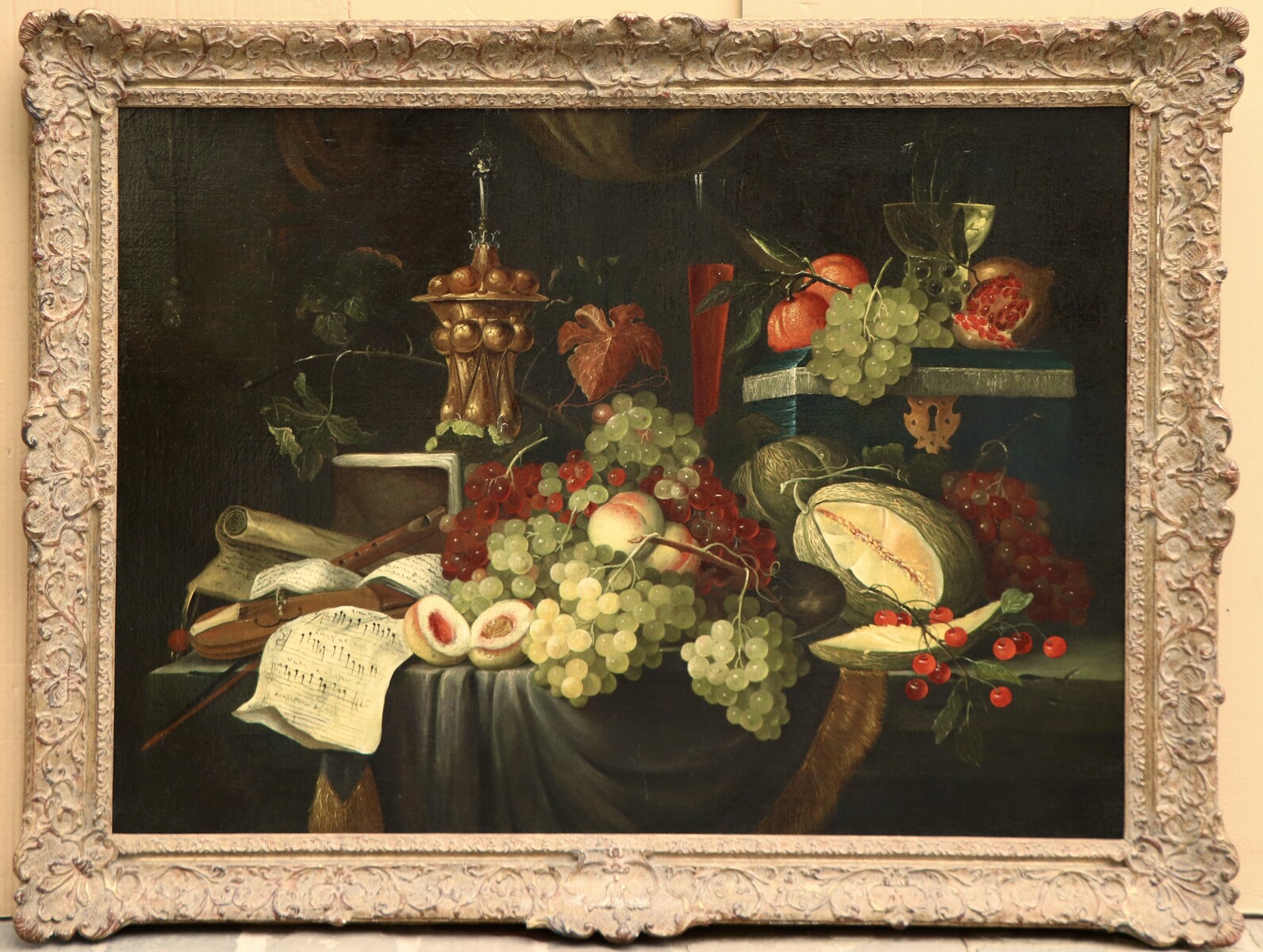
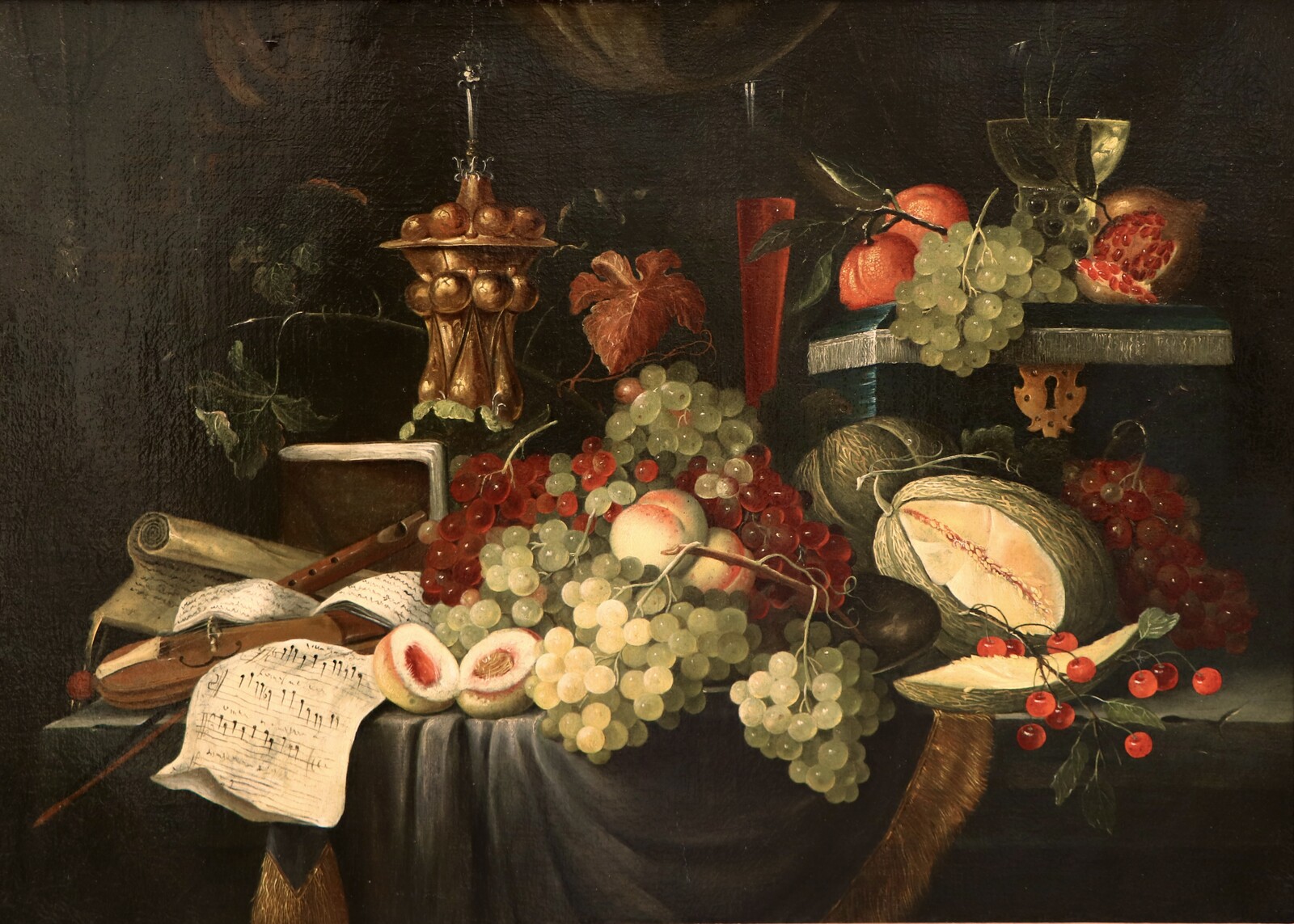
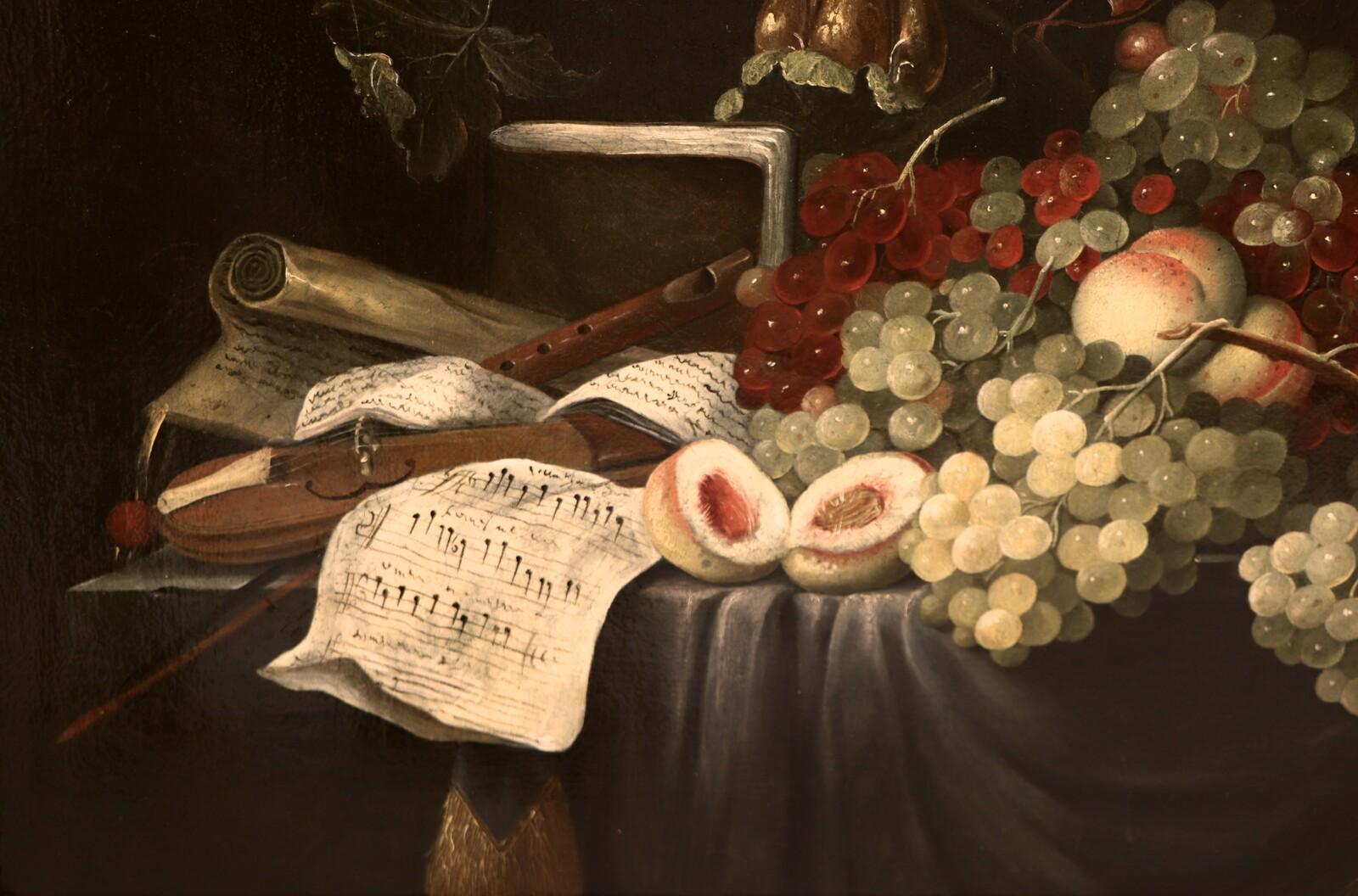
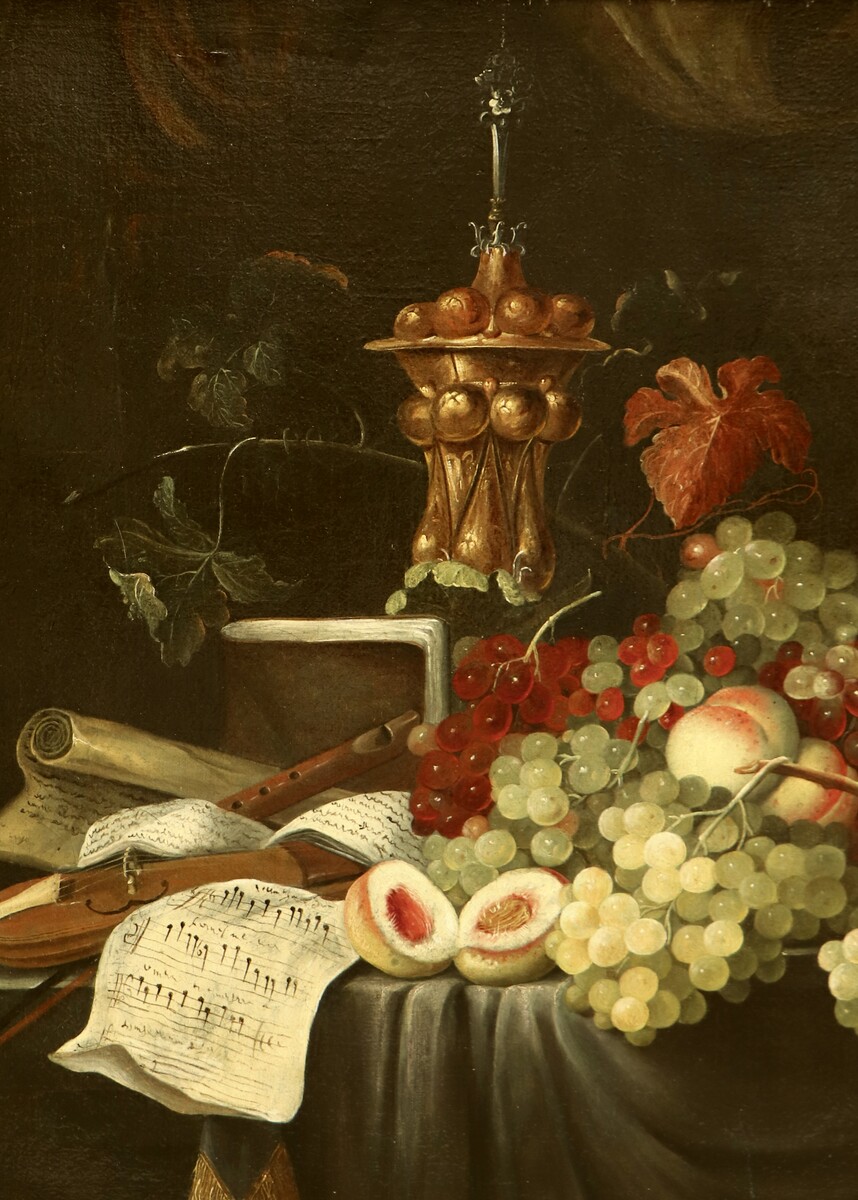
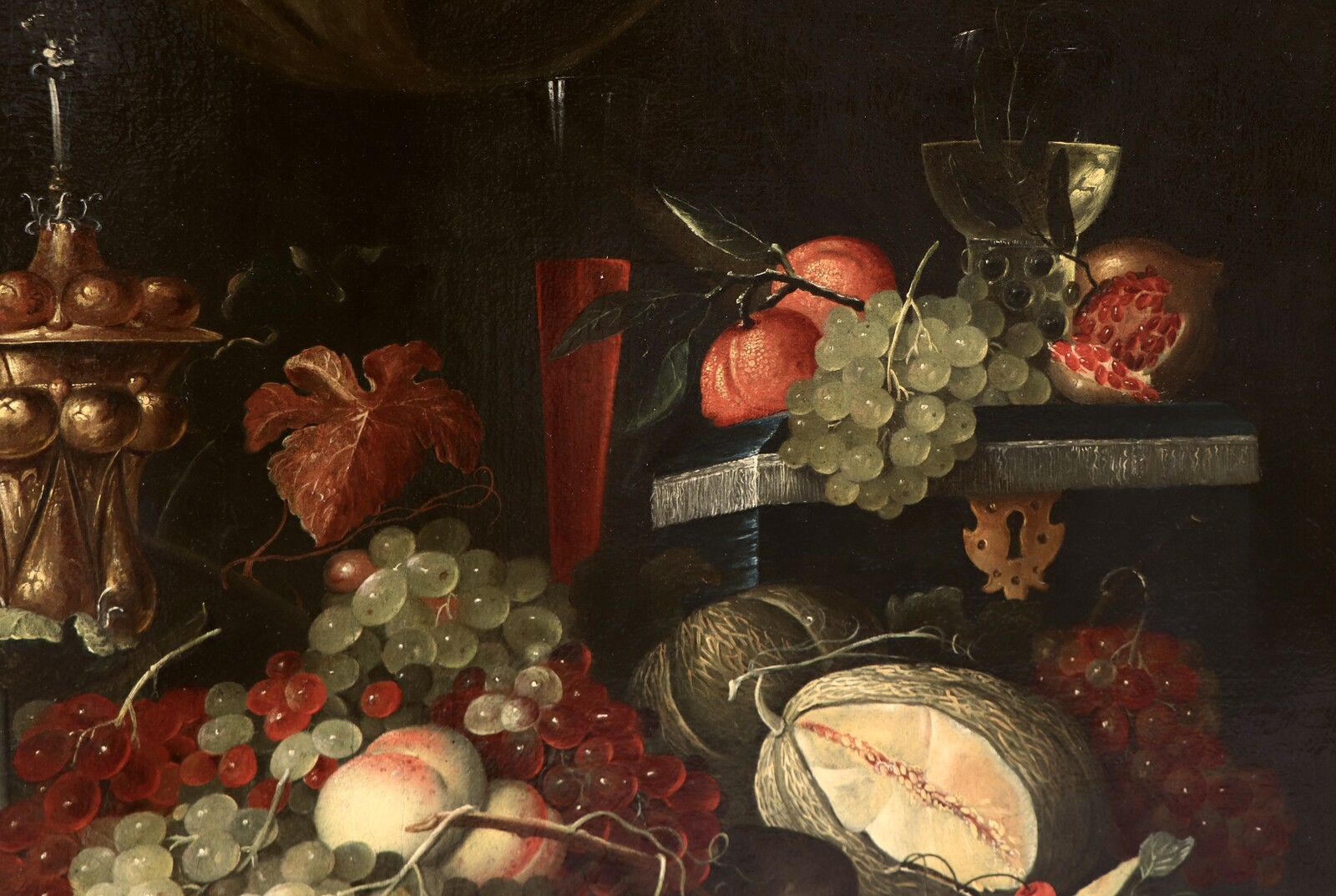
A Pronk still life with fruit, a Columbine cup, a Roemer glass on a blue casket, sheets of music and instruments
Oil on canvas : 80,8 X 110,8 cm
Unsigned
Frame : 97,1 X 128,7 cm
I would like to thank Dr. Fred Meijer who has given the attribution
Provenance: the William Humphreys Art Gallery in Kimberley,
South Africa
Published by Carmen, J. (1994). 'Seventeenth-century Dutch and Flemish paintings in South Africa: A Checklist of Paintings in Public Collections'. Johannesburg: Johannesburg Art Gallery, illustrated on p.47.
Our cost price 21.538 €
= acquisition price 18.989 € + expences 2.549 € (shipment 125 + import tax 2.000 € + restoration 424 €)
Our profit 30 %
"All paintings are fully documented with texts and photographs of comparative items. All this information is removed from our website once the painting is sold".
SOLD
In short
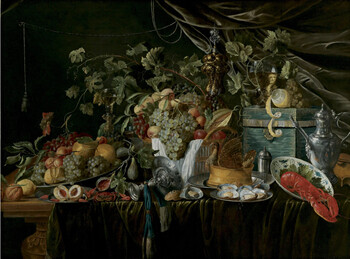
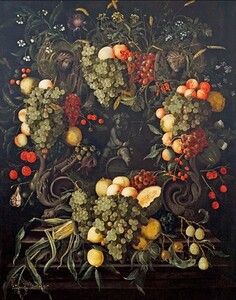
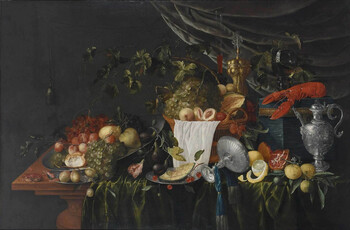
There are very few of these opulent still lifes known by the mysterious Antwerp painter W. Mertens. He was active in Antwerp during the third quarter of the 17th century, where he was influenced by the greatest still life painter of the Low Countries, Jan Davidsz. de Heem.
It is thought that the abbreviation W refers to an alias of the still life painter Cornelis Mertens, of whom no other paintings are known.
I discovered this painting in South Africa of all places, where the diamond mining company De Beers sold pieces from the William Humphreys Art Gallery in Kimberley, which were exhibited in that museum for over 50 years. Kimberley is known for its huge, rich diamond mine.
I discovered this painting in South Africa of all places, where the diamond mining company De Beers sold pieces from the William Humphreys Art Gallery in Kimberley, which were exhibited in that museum for over 50 years. Kimberley is known for its huge, rich diamond mine.
About W. Mertens
Flemish painter
Active in Antwerp circa 1650/1675.
Rare painter of fruit still life and of so-called Pronk still lifes (sumptuous still lifes including luxurious objects).
It is not known whom Mertens studied painting with. He was clearly influenced by Jan Davidsz. de Heem (Utrecht 1603 – 1683/84 Antwerp), one of the most, if not the most important 17th century “Dutch” still life painters. Jan was indeed born and trained in Holland, but he bloomed in Flanders, in Antwerp. In the early 1630s he moved with his wife and son Cornelis from Leiden to Antwerp, where he spent his most productive years until the end of the 1650s. Jan must then have lived the major part of the 1660s in Utrecht until the French invasion of Holland in 1672, when he fled, as so many of his colleagues, back to Antwerp. He remained here until his death in 1683 or 1684.
Some of Mertens’ scarce paintings are fully signed “W. Mertens”. Not a single painting shows his first name in full. Based on confusion with an embroidery worker named Wouter Mertens, who was inscribed in the Antwerp Guild of Saint Luke in the guild year 1641/1642, W. Mertens was in the past erroneously called Wouter Mertens.
Remains the question of the correct identification of our painter, for a painter could not be active in Antwerp without registering in the local Painter’s Guild. This is indeed no W. Mertens in these registers.
According to the expert Fred Meijer the “W” could well be the first letter of an alias, for example of “Witte” (White). He states that our W. Mertens might therefore well be the still life painter Cornelis Mertens. He became a Master in the Antwerp Painter’s Guild in the year 1656/1657 and he was last recorded there in the year 1692/1693. Therefore the dates of paintings ascribed to our W. Mertens coincide exactly with the years of activity of the still life painter Cornelis Mertens.
It might also be that Mertens was just related to Cornelis Mertens or to his son, Thomas Mertens, who was also a fruit still life painter; he became a Master in 1670. According to Fred Meijer he was not as competent as our painter. Still some paintings by W. Mertens might go hidden under attributions to Thomas Mertens and to other contemporary Antwerp painters who were also influenced by Jan Davidsz. de Heem: for example Joris van Son and Jan Pauwel Gillemans the Elder.
About some objects in our painting
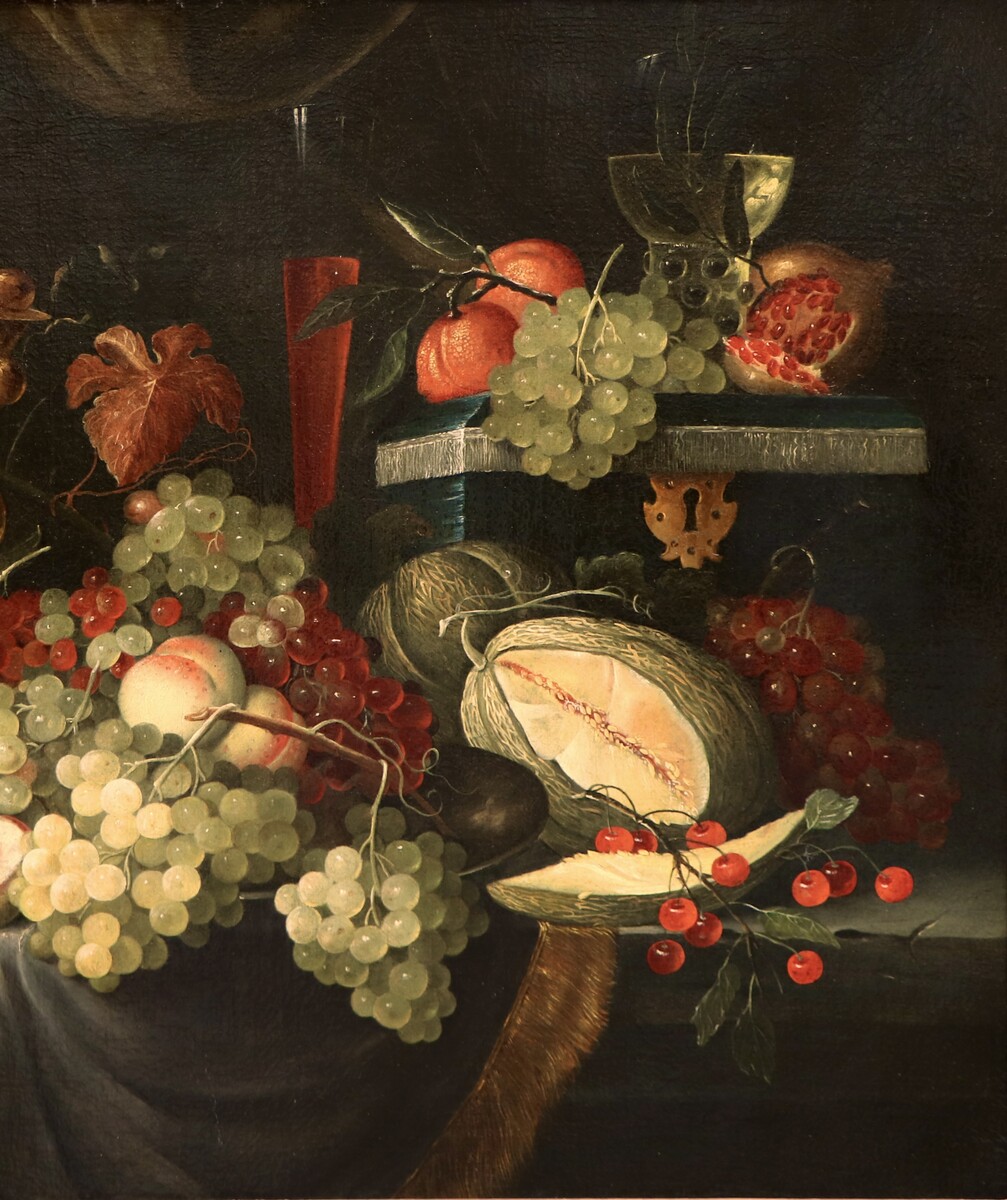
The blue casket at right is a decorative prop that often occurs in compositions by Jan Davidsz. de Heem.
The typical German Roemer glass on top of the casket is filled with white wine. It is easily recognizable by its decoration of the stem with prunts to ensure a safe grip. The Dutch and Flemish imported much white wine from the valleys of the Rhine and Moselle.
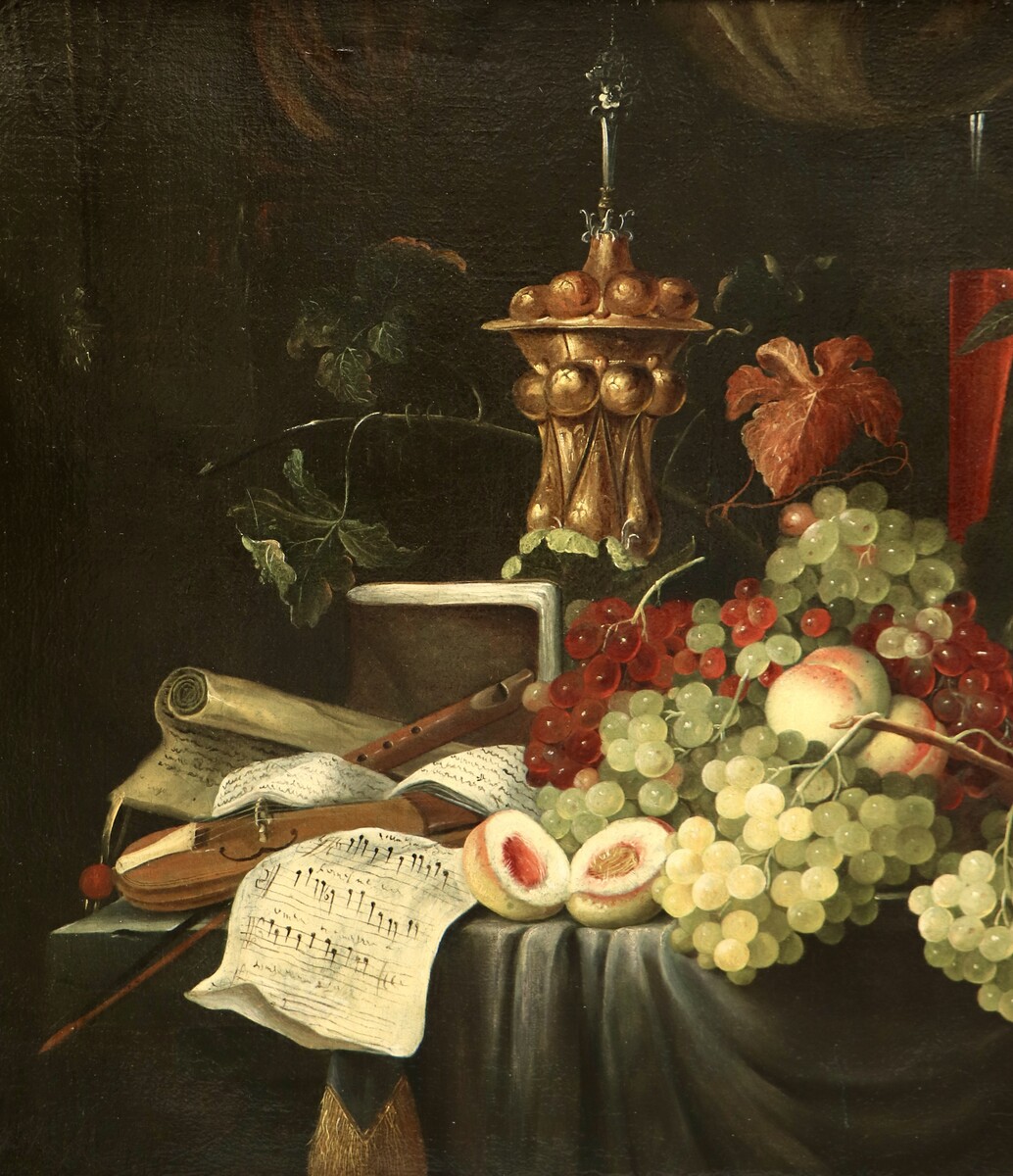
The columbine cup at left is also of German origin, most probably from Nuremberg. Such a silver goblet, named “Ackleibecher” in German, has the form of an inverted columbine flower.
About the provenance of our painting
William Benbow Humphreys (1889–1965) was a South African statesman, businessman and devoted patron of the arts, whose passion for collecting paintings, sculptures, furniture and objets d’art during buying trips in Europe laid the foundation of one of South Africa’s most significant regional museums, the William Humphreys Art Gallery in Kimberley, the diamond mining capital of the country.
This museum openend already in 1952. In 1971 De Beers, the British mulinational diamond company, acquired the complete Humphreys Collection and placed it on long-term loan to the Gallery, ensuring that the works remained in Kimberley for over half a century.
Following the cessation of the long term loan arrangement with the museum De Beers decided to sell septembre 2025 the complete Humphreys collection at auction, at Aspire, in Johannesburg. I was able to buy this exceptional painting at that auction.
When William Humphreys acquired our painting and when it entered in the museum in Kimberley it was in effect thought that it had been painted by Joris van Son. The museum label (number 260) on the backside mentions as painter “Jan van Zoon”, as zoon is the Dutch word for son.
Why should you buy this painting?
Because it is it a great Pronk (luxurious) still life, painted in the tradition of the illustrious Jan Davidsz. de Heem in Antwerp.
Comparative paintings
Click photos for more details