25.000 €
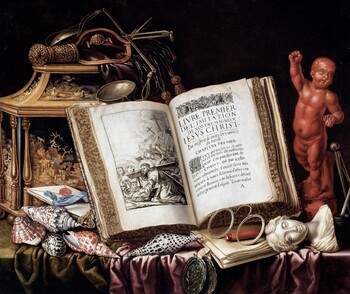
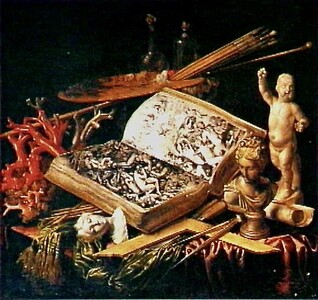
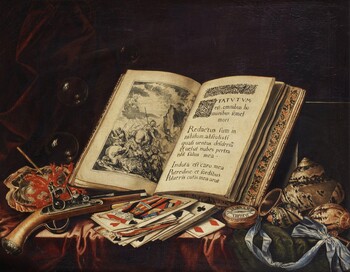
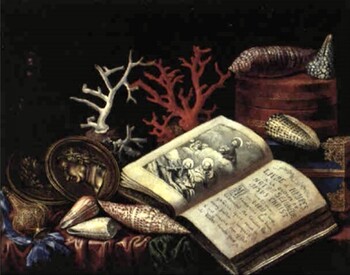
Still life with a jewellery box, playing cards, exotic shells, letters, red coral, a small statue of a putto and an inkwell with a feather pen
Oil on canvas : 34,4 X 44,0 cm
Unsigned
Frame : 47,2 X 57,1 cm
Dr. Fred Meijer has confirmed the attribution in full to Carstiaen Luyckx.
Absolute transparency: our consignation price = 21.350 €
Our export price = 24.367 €


In short
Carstiaen Luyckx was a versatile and interesting Antwerp still life painter. Next to his traditional, high quality flower still lifes, garlands, Pronk and hunting still lifes he also painted very original subjects with Vanitas themes, forest floors and a few very nice bird scenes.
It is thought that during the second half of the 1650s Luyckx moved to present-day Northern France, where he painted Vanitas still lifes, such as ours.
About Carstiaen Luyckx
Flemish painter
Antwerp 1623 – circa 1670 Antwerp
Still life painter.
His first name is sometimes spelt Carstian or even Christiaen.
Pupil in Antwerp of the still life painter Philip de Marlier in 1640 and from 1642 onwards of Frans Francken III. In his paintings neither one of them left their mark on his mature style. One does see the influence of Jan Davidsz. de Heem, of Daniel Seghers and of Jan Fyt (this last one on his hunting still lifes).
From 1645 onwards member of the Painter’s Guild of Saint Luke in Antwerp. In 1646 he is recorded as court painter to King Philip IV of Spain.
There are only two dated paintings known by Luyckx, both from 1650.
It is thought that Luyckx remained in Antwerp at least until the late 1650s: in 1652 he painted a mortuary crown for the deceased painter Victor Wolfvoet II, in 1653 his son (from his second marriage) was born here and he collaborated with David Teniers II and with Nicolaes van Verendael on a painting signed by all three, kept today in Dresden (Teniers and Verendael are documented in those years in Antwerp).
Subsequently Carstiaen Luyckx is thought to have left Antwerp, settling in France, probably in present-day Northern France. Until now no traces of his stay there have been found. In 1644 he had already gone to Lille, but he had returned to Antwerp for his first marriage in 1645.
From 1649 onwards a fair number of his paintings turned out in the Dutch Republic, but there is no reason to think that at some stage he might also have moved northwards.
Luyckx was a versatile still life painter who painted Vanitas, hunting, flower and also a few fish and “pronk” still lifes.
His hunting still lifes, sometimes monogrammed “CL” or “KL”, were only fairly recently attributed to our painter. They are strongly influenced by the Flemish painter Jan Fyt. Some of them are actually still erroneously attributed to Jan Fyt, for example a painting in the Pushkin Museum in Moscow. Fred Meijer dates Luyckx’ hunting still lifes rather late in the artist’s oeuvre. In these years his style became more graphic.
About Carstiaen Luyckx’s Vanitas still lifes
Luyckx’s Vanitas still lifes date from the latter years of his career, when our Flemish painter lived and worked most probably in current Northern France, a region that then still belonged to the Spanish Low Countries.
In 1667/68, during the War of Devolution, the young king of France, Louis XIV (1643 – 1715) succeeded in conquering on the Spaniards large parts of Flanders (Lille, Douai, Courtrai, Charleroi and Tournai). Lille and Douai still belong to France. Our painter passed away circa 1670.
In the past Luyckx’s Vanitas still lifes were erroneously attributed to the French painter Simon Renard de Saint-André (Paris 1614 – 1677), until Dr. Fred Meijer rectified these mistakes from the middle of the 1990s onwards. In fact, Simon Renard de Saint-André was influenced by our Carstiaen Luyckx. The only signed Vanitas still life by Renard de Saint-André is actually a copy of a Vanitas still life with a skull by Luyckx; that copy sits today at the Musée Tavet in Pontoise.
Why should you buy this painting?
Because it is a small gem painted by a great artist.
Comparative paintings
Click photos for more details