the pair 11.000 €
An unidentified Flemish painter, most probably active in Frankfurt circa 1590-1600
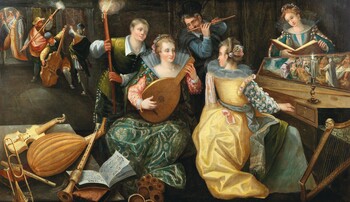
The Allegories of Hearing and of Taste
Both oil on panel : 64,6 X 49,2 cm and 64,7 X 48,8 cm
Both unsigned
Frames : 79,2 X 63,7 cm and 79,0 X 63,7 cm
Absolute transparency: our cost price = 8.252 €
= acquisition price 4.554 € + shipment 188 € + restoration 3.510 €
Our export price 10.523 €


In short
Around 1585 many wealthy Protestants fled from Antwerp, Brussels and other Flemish towns to Frankfurt: they soon enriched the town financially, economically and culturally. These two paintings testify of the link between Flanders and Frankfurt.
About Joos van Winghe
Flemish Mannerist painter
Brussels 1544 – 1603 Frankfurt
Painter of genre scenes, portraits and history scenes.
Probably pupil of Peter de Kempeneer, together with Hans Speckaert and Aert Mijtens.
Between 1564 and 1568 he stayed in Rome, most probably with Cardinal Alessandro Farnese (the grandson, yes indeed, of Pope Paul III), who introduced him to the Emilian painter Jacopo Bertoja. Van Winghe and Bartholomeus Spranger assisted Il Bertoja for the fresco decoration of the Farnese Palace in Caprarola, N. of Rome.
In 1568 van Winghe returned to Brussels via Fontainebleau and Paris. Back home he turned Calvinist.
In most of the important Flemish towns (Antwerp, Brussels, Ghent, Bruges, Ypres) radical Protestants seized power and installed Calvinist Republics in 1577/1578. King Philip II of Spain appointed a new governor in the Spanish Netherlands, Alessandro Farnese (a name-sake of the Cardinal, whom van Winghe had worked for in Italy). This great general and patient diplomat was able to seize all these revolutionary centres by 1584/1585. Brussels fell in March 1585 into his hands after a siege that lasted for ten months. Van Winghe, who was actually a court painter of the governor, had been one of the Protestant negotiators with Farnese during the discussions about the surrender of the town. The inhabitants of Brussels were allowed to choose between conversion to Catholicism or leaving the town.
Van Winghe left for Frankfurt, in Germany. He stayed here until his death in 1603 (of the plague).
Master in Brussels of Hendrick de Clerck and in Frankfurt of his own son, Jeremias (1578 – 1645).
About the Flemish community in Frankfurt
Many wealthy Flemish Calvinists, especially from Antwerp, settled in Frankfurt.
A fair number of them were artists:
- painters such as Lucas van Valckenborch and his nephews Frederik and Gillis, Joris Hoefnagel, Hans Vredeman de Vries, Frans Badens and Hendrick van der Borcht I;
- engravers such as Crispijn de Passe I, Jan and Raphael I de Sadeler, Theodor de Bry and Jacob Hoefnagel.
About fashion in Frankfurt at the end of the 16th century
The high open-front lace collars (also known as fan ruffs or standing collars) that both ladies are wearing in our paintings were typical of the elite fashion in Frankfurt. They rise sharply behind the neck, framing the woman's head like a fan and displaying her décolletage and neck. They were constructed by attaching costly bobbin or needle lace to fine linen. They required rigid wire frames (supportasses) underneath and heavy starching with specialized heated irons to stay upright. These costly lace ruffs (the lace was probably imported from Antwerp) displayed the extreme wealth and status of these ladies who, in Frankfurt, felt free from the severe religious austerity found elsewhere.
The two men are both wearing typical millstone ruffs.
About the lid of the clavichord: anti-Catholic propaganda
It is decorated with a scene from ancient Roman history: Emperor Nero playing music while Rome is burning in 64 AD. For Protestant artists the atrocities of pagan Rome were equally terrible to those of the contemporary Catholic Church. Thus Nero stands here for the Pope.
Why should you buy these two paintings?
Because these two beautiful scenes document a period of cultural interchange at the very end of the 16th century.
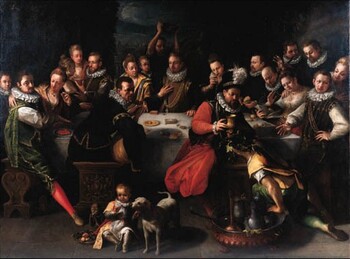
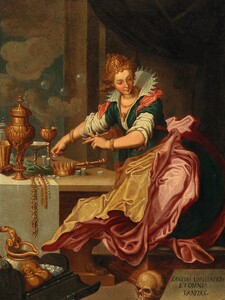
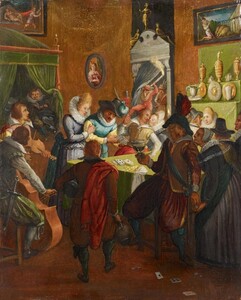
Comparative paintings
Click photos for more details