6.000 €
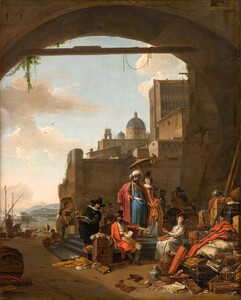
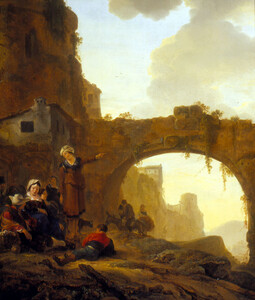
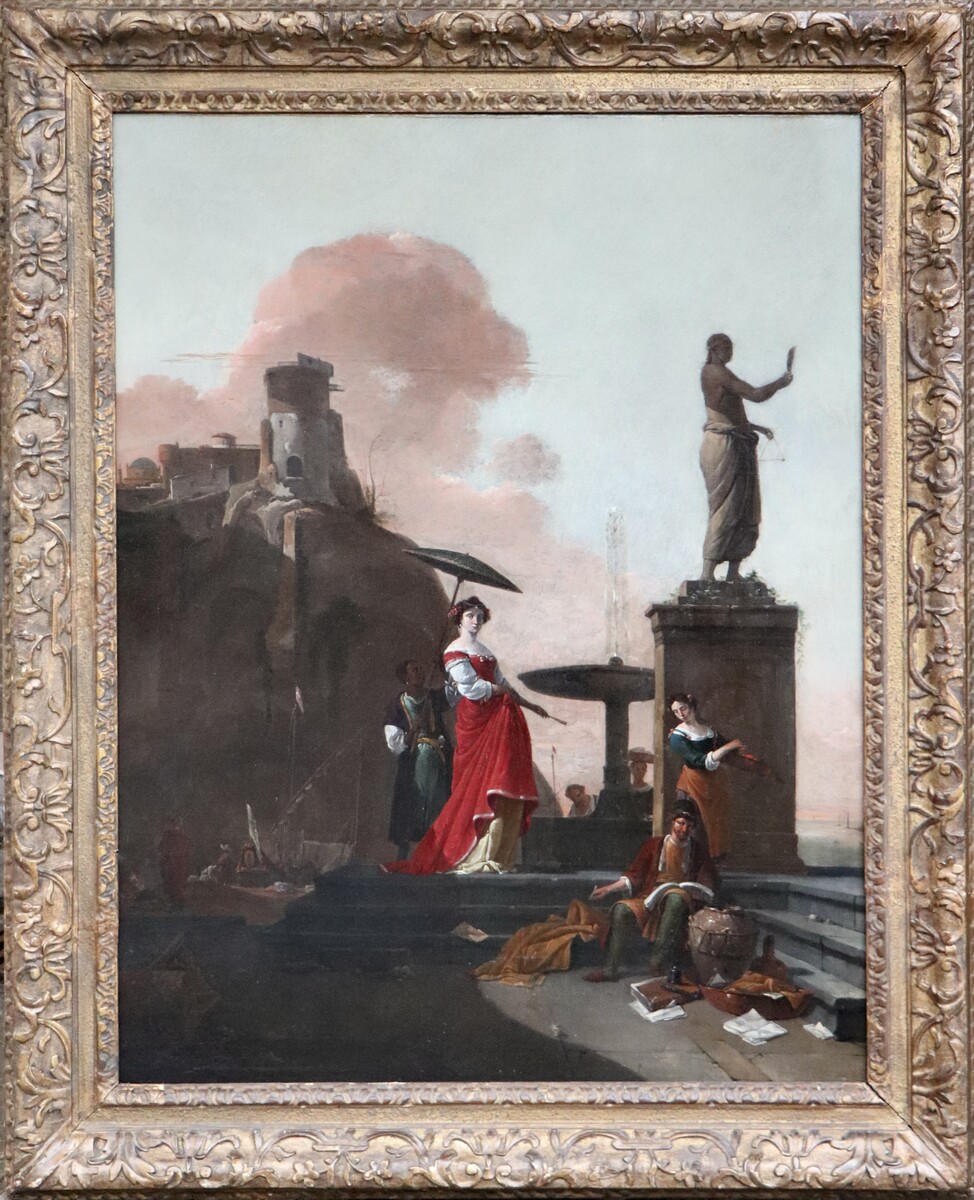
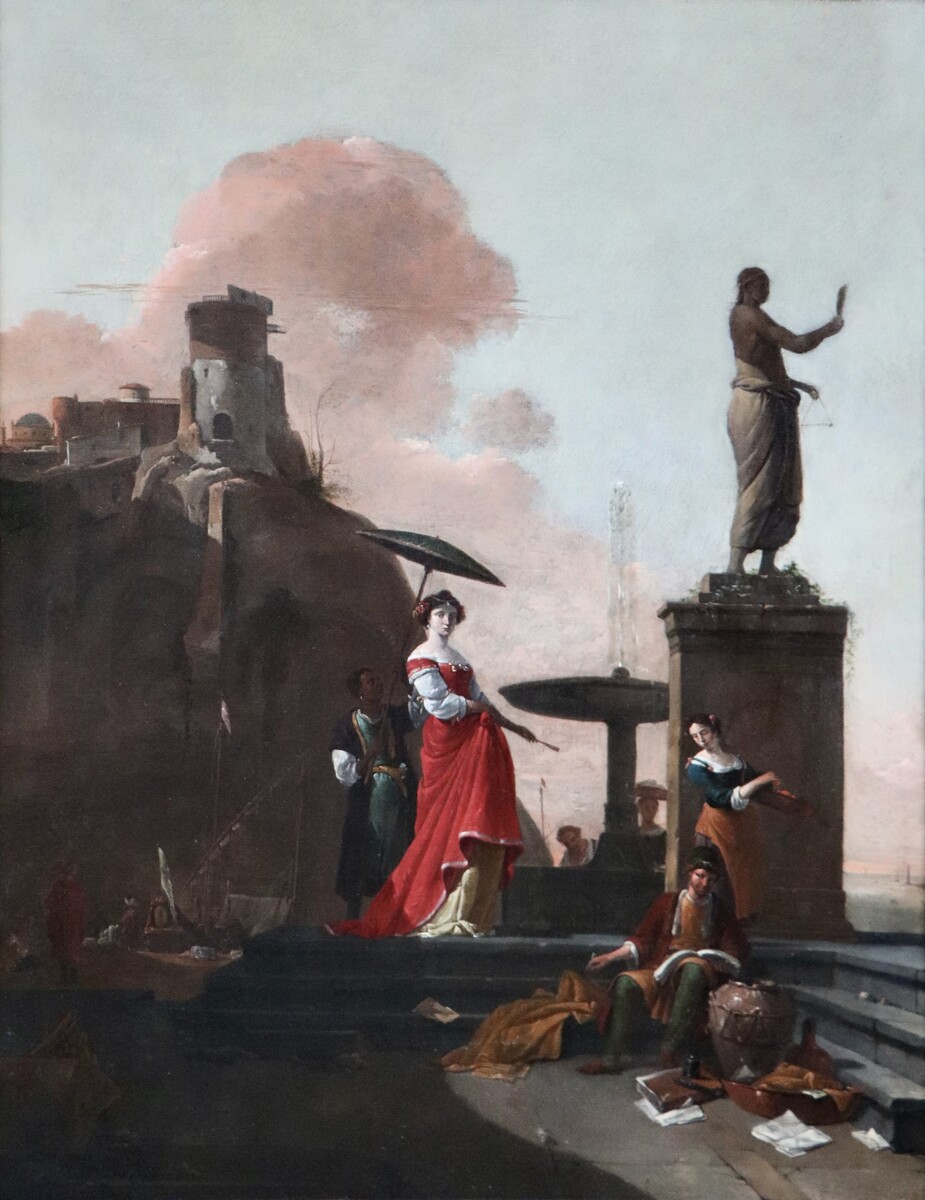
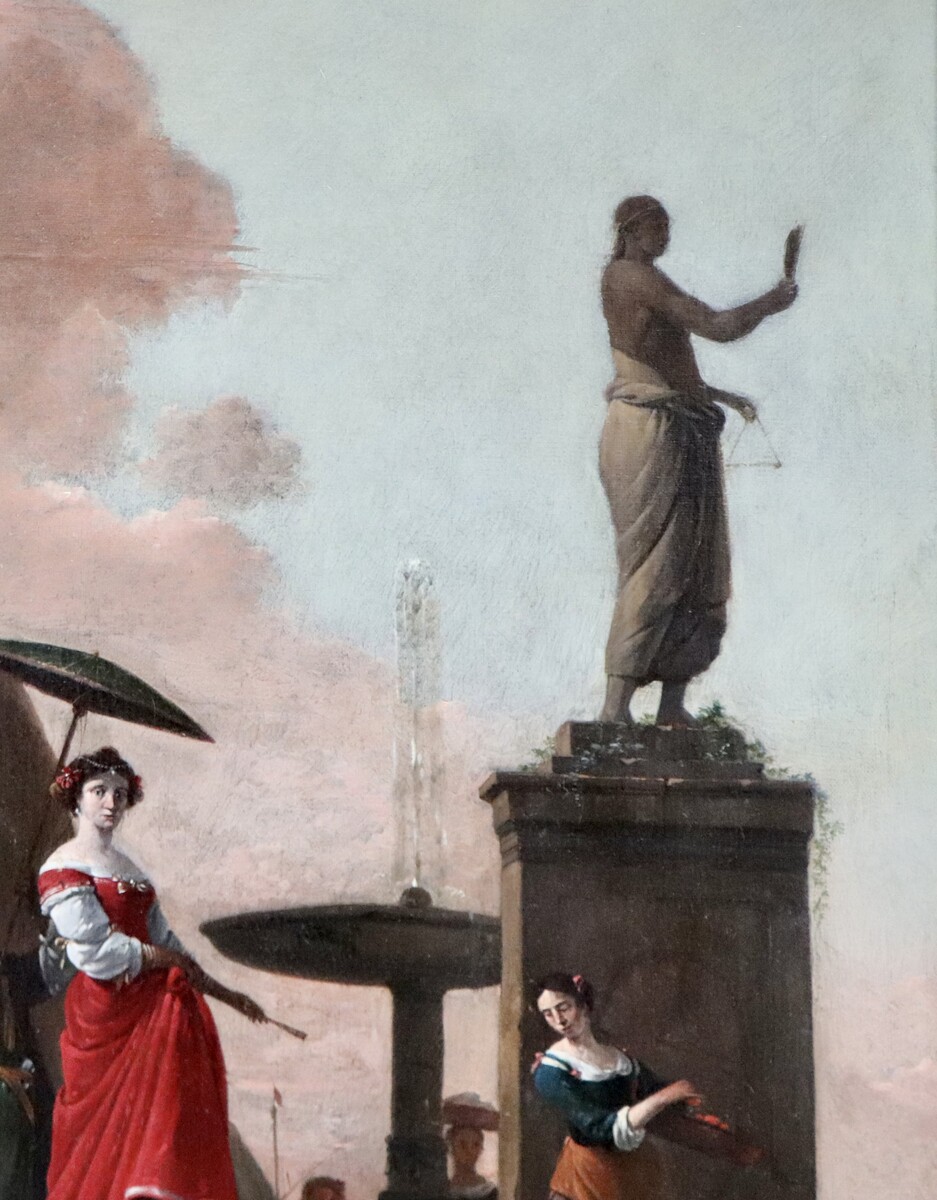
An Italianate harbour scene
Oil on canvas : 82,0 X 63,8 cm
Unsigned
Frame : 99,7 X 81,0 cm
Absolute transparency: our cost price = 3.675 €
= acquisition price 2.560 € + shipment 329 € + restoration 786 €
Our export price 5.596 €
In short
Wijck stayed in Rome in the early 1640s. At his return from Italy he continued painting Italianate subjects. These Southern harbour views are generally dated circa 1660; in that year our painter moved for at least six years from Haarlem to London.
In a completely different port scene by Wijck from the Musée Fabre in Montpellier also appear our main figures, telling a very interesting story of “international business”.
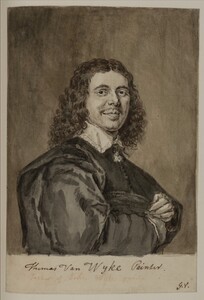
About Thomas Wijck
Dutch painter
Beverwijk circa 1616 – 1677 Haarlem
Painter of Italianate scenes (harbour scenes and genre scenes set in popular quarters of Rome), of Dutch interior scenes and of interiors with alchemists.
It is not known whom he studied under, but it must have been in Haarlem, some 15 km south of his native Beverwijk.
Wijck travelled to Rome, where he is documented in 1640.
He was already back in Haarlem in 1642, when he joined the Painter’s Guild of Saint Luke; in 1644 he married here.
It is not thought that Wijck ever returned to Italy. Given the large number of Italianate scenes he must have continued painting these after his return to Holland.
He was active in Haarlem from 1642 until 1660.
Thereafter he left for England, where he lived from 1660 until 1666. He painted the city of London before and after the Great Fire of 1666.
He is again documented in Haarlem from 1669 until his death in 1677.
In his last years Wijck produced typical Dutch genre paintings and above all alchemist interiors.
Thomas Wijck was the father and master of the lesser known Jan Wijck (Haarlem 1644 – 1702 Mortlake, England).
About our painting
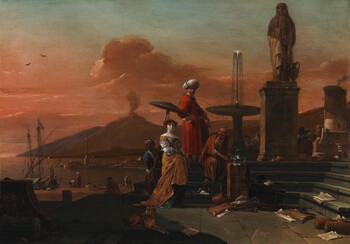
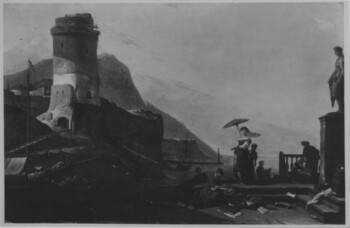
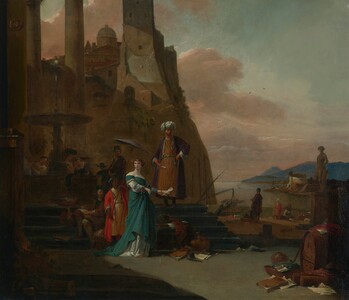
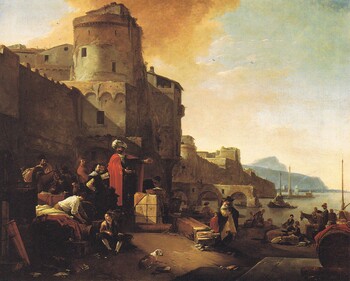
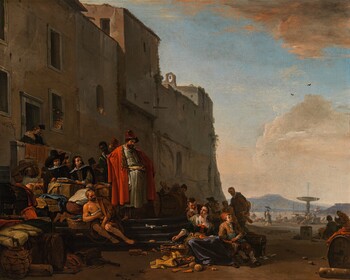
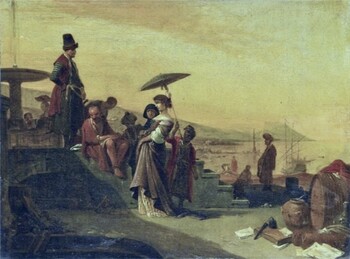
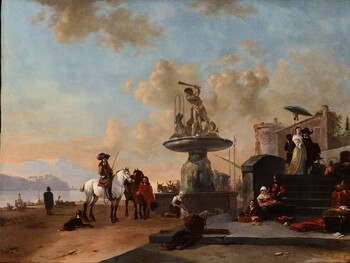
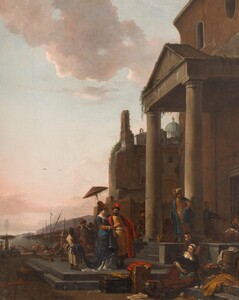
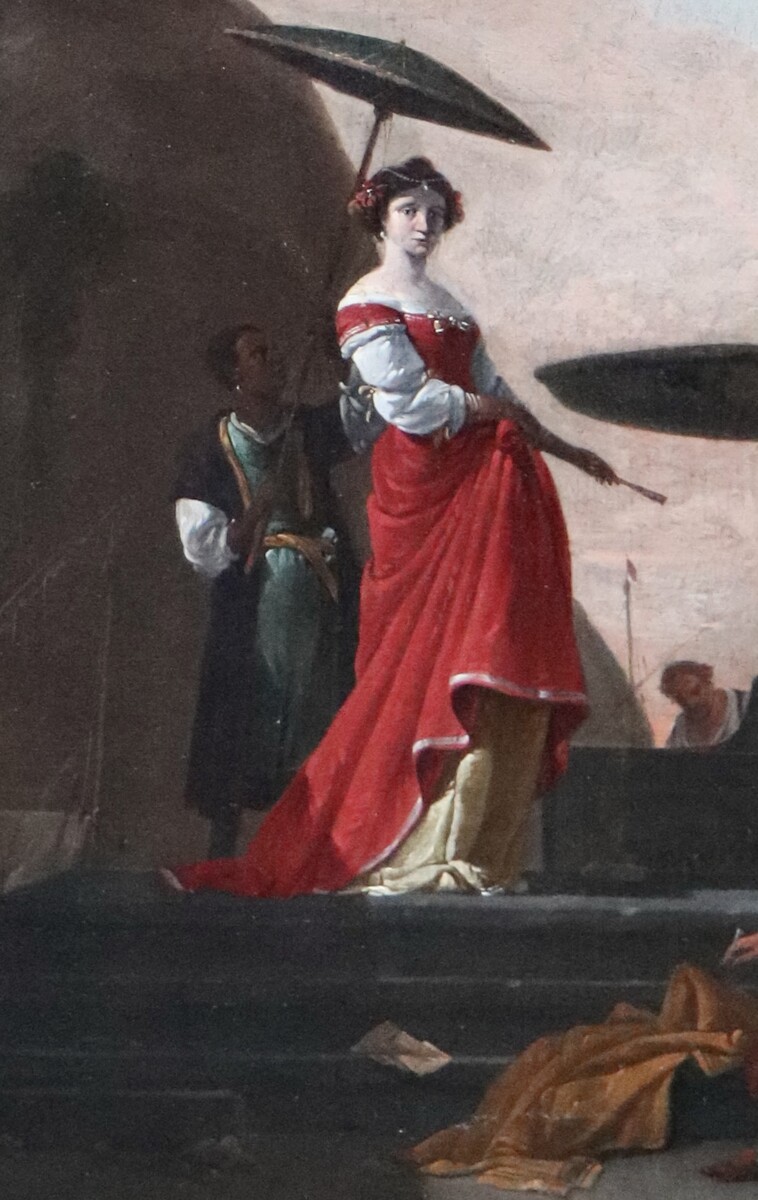
As you may see in our comparative paintings, Italianate harbour views with an elegant lady standing in the shade of an umbrella were a popular theme of Thomas Wijck.
Our painting seems to be related to a signed work by Thomas Wijck from the Musée Fabre in Montpellier. In that composition one sees a Turkish pirate with his concubine, selling goods to a Jewish dealer, whose Dutch secretary is making a list of the numerous goods. That scene is set in Rome.
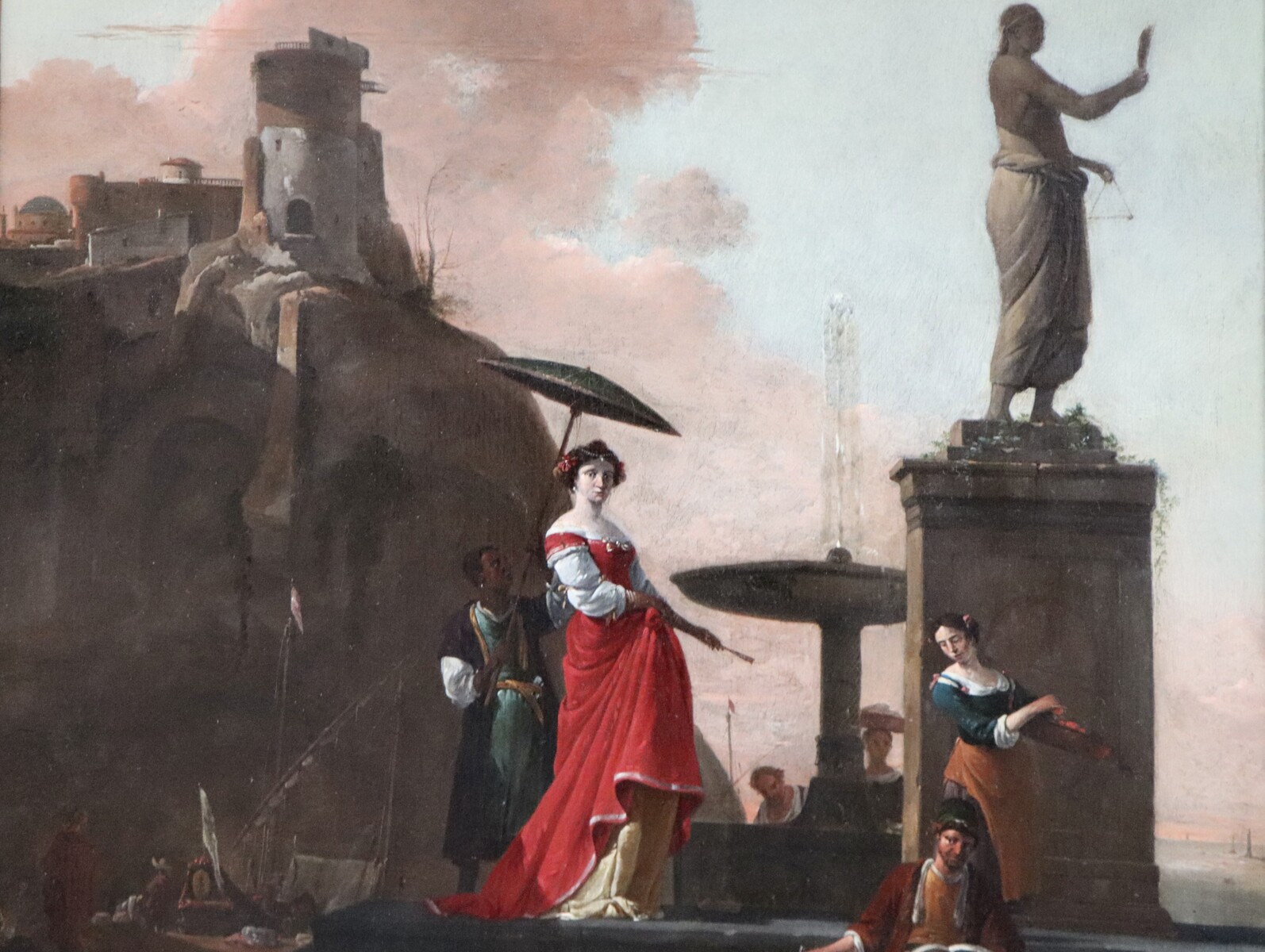
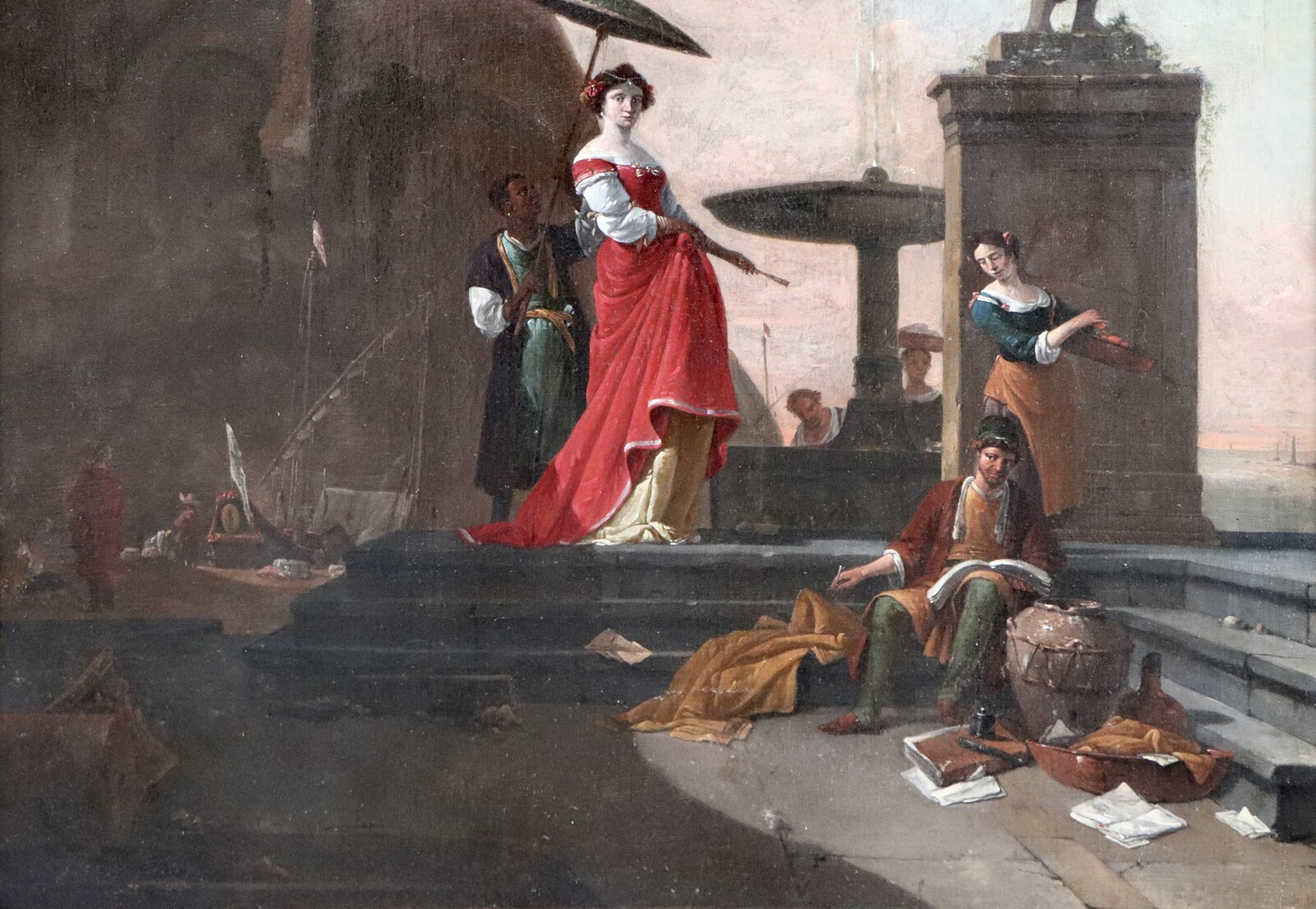
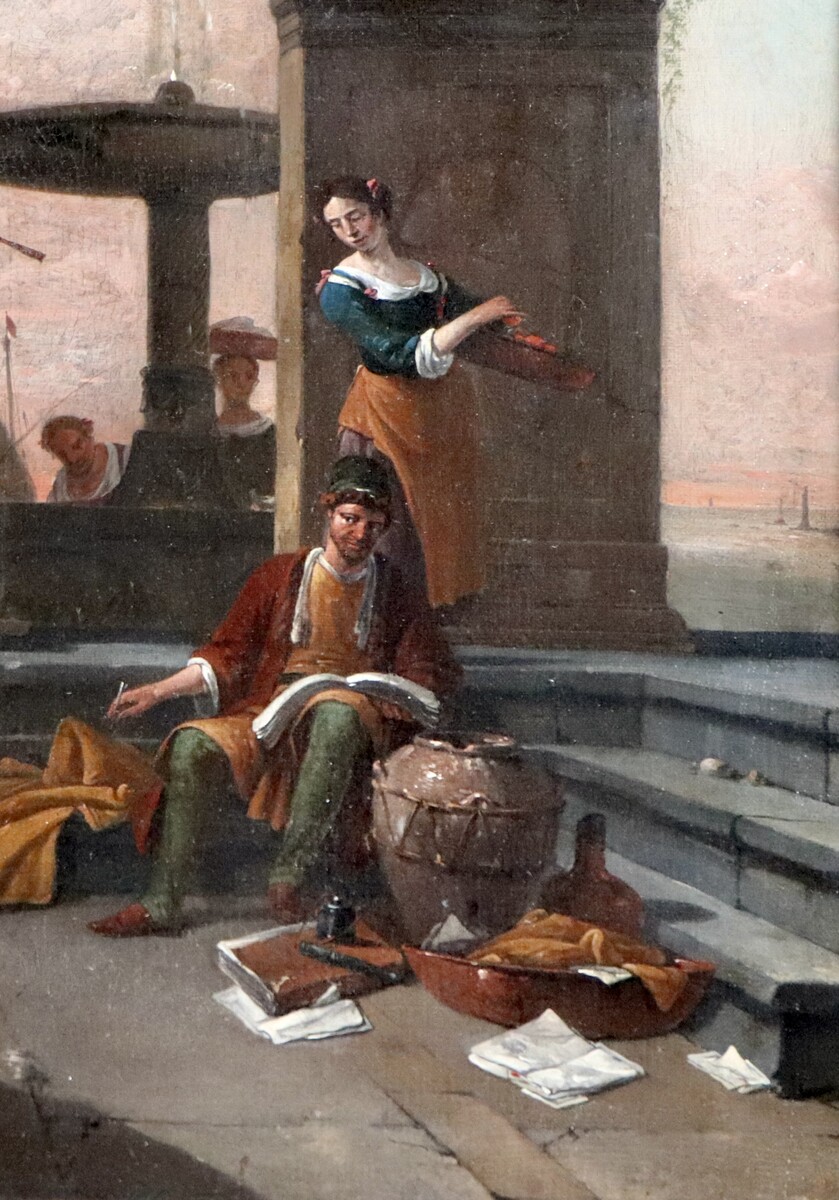
The three main figures in our painting, the sophisticated lady, the Blackamoor carrying her umbrella and the Jewish figure wearing a tall hat trimmed with fur, who is writing down the goods here himself, appear also in that completely different composition from the Musée Fabre. Even a similar tall jar (here in front of the seated Jew) appears in that composition. Finally the Turkish figure that is identified in the Montpellier painting as a pirate, overlooks here in the left background the loading or unloading of goods.
In many of Wijck’s Italianate harbours appears a Turkish, Ottoman figure.
Besides our comparative works I should mention paintings kept at the Rijksmuseum of Amsterdam, the Staatsgalerie of Augsburg, the Museum Stiftung Jakob Briner in Winterthur or the Museum der Bildenden Künste in Leipzig.
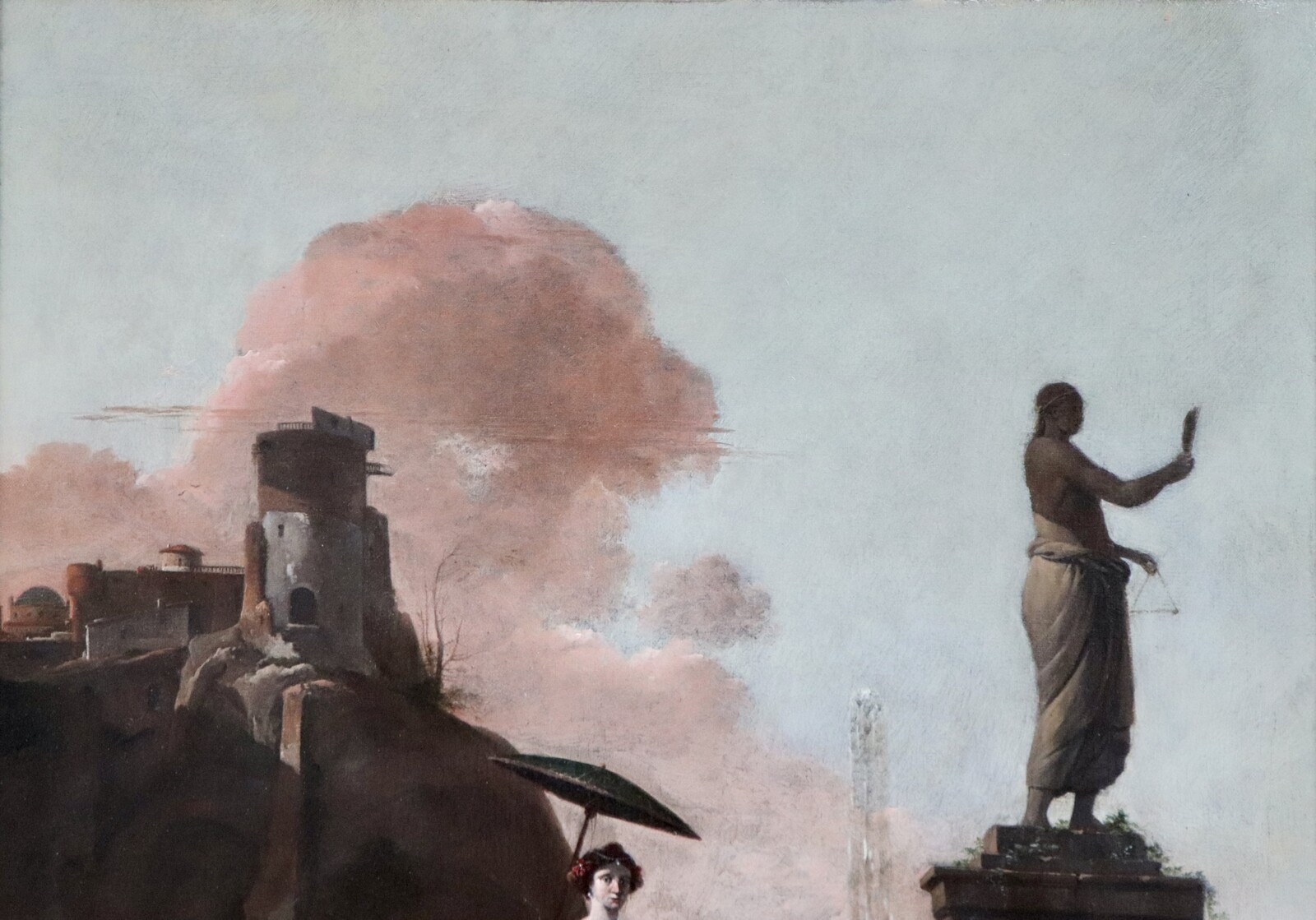
It is interesting to note the large statue at right: could that represent an Egyptian figure? Might that refer to the nationality of our Ottoman figure at left?
I should also mention that the same fountain as ours can also be found in several of Wijck’s other port views.
Wijck’s harbour views are generally signed, ours is not. They all must date from circa 1660, at a period when Wijck was being strongly influenced by Jan Baptist Weenix (1621 – 160/61) and by Nicolaes Berchem (1620 – 1683).
Why should you buy this painting?
Because it is a great vertical composition holding Wijck’s iconic elegant lady standing in the shade of an umbrella.
Comparative paintings
Click photos for more details