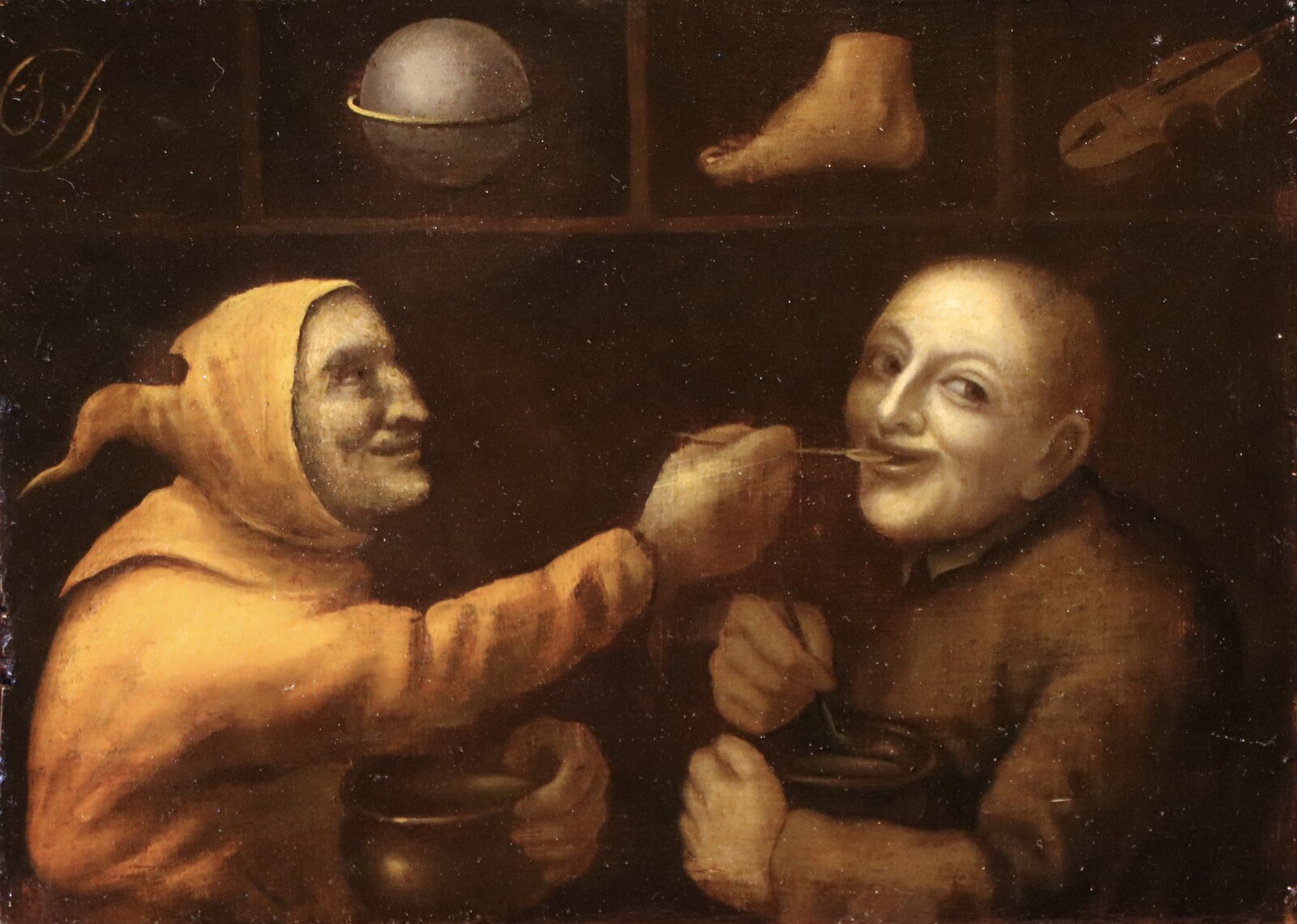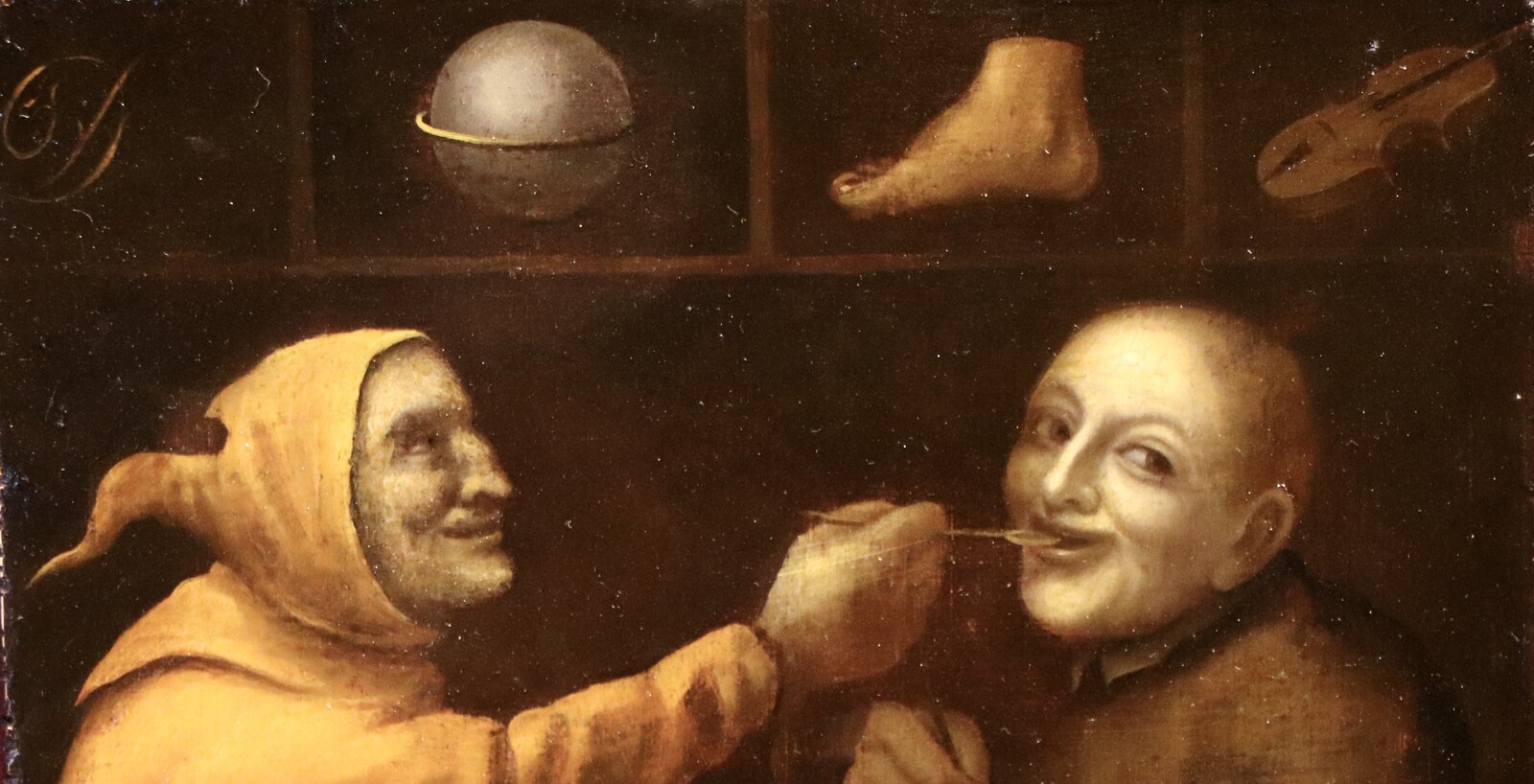
The world feeds many fools
Oil on panel : 17,4 X 24,1 cm
Unsigned
Currently unframed
About our painting
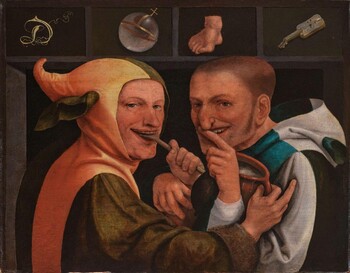
Our crude, comical painting goes back to an early composition by Jan Massys (1509 – 1575) from around 1530, now in the Phoebus Foundation.
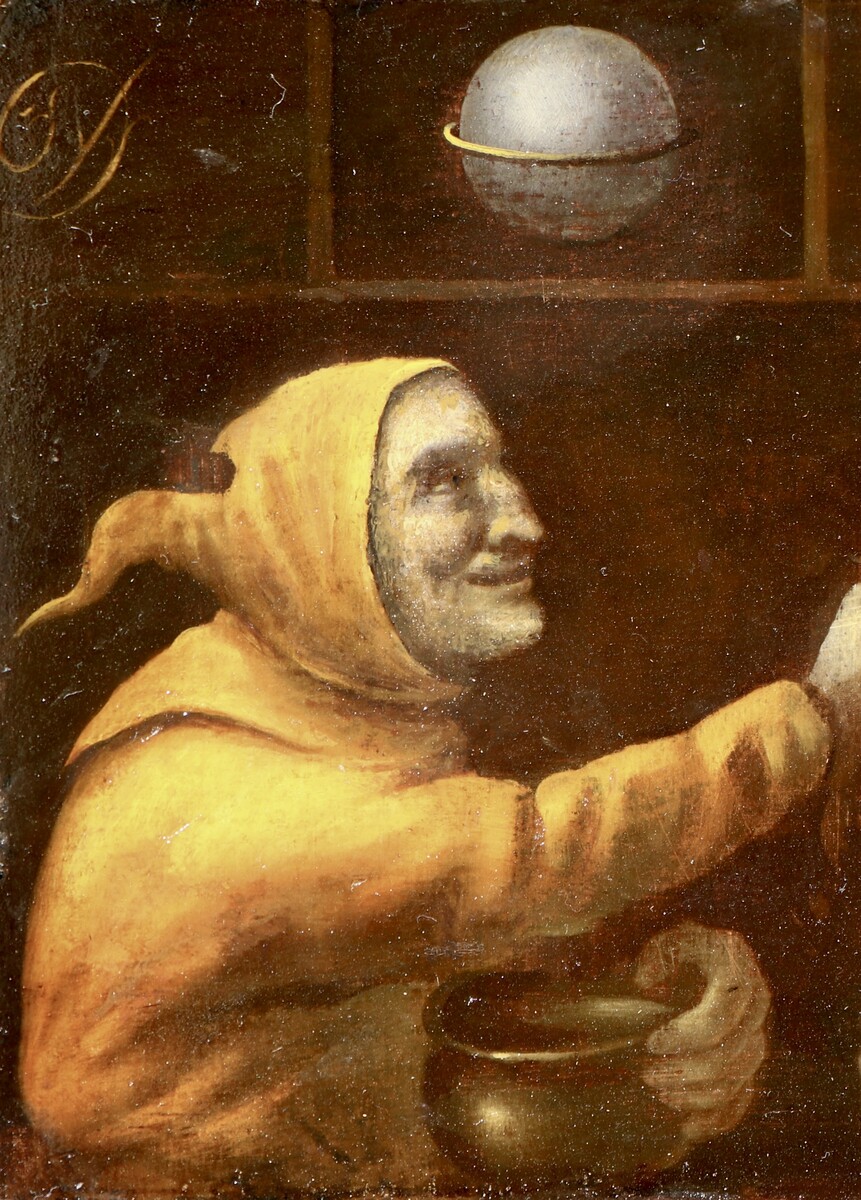
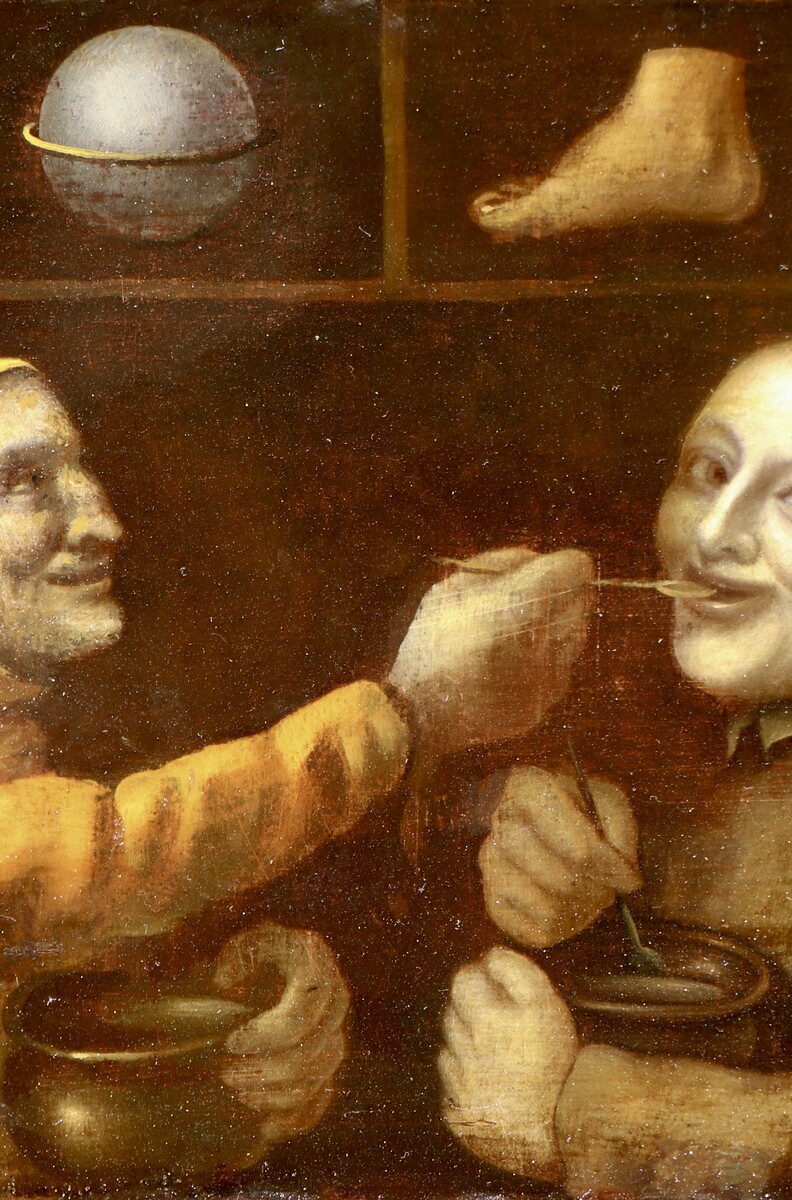
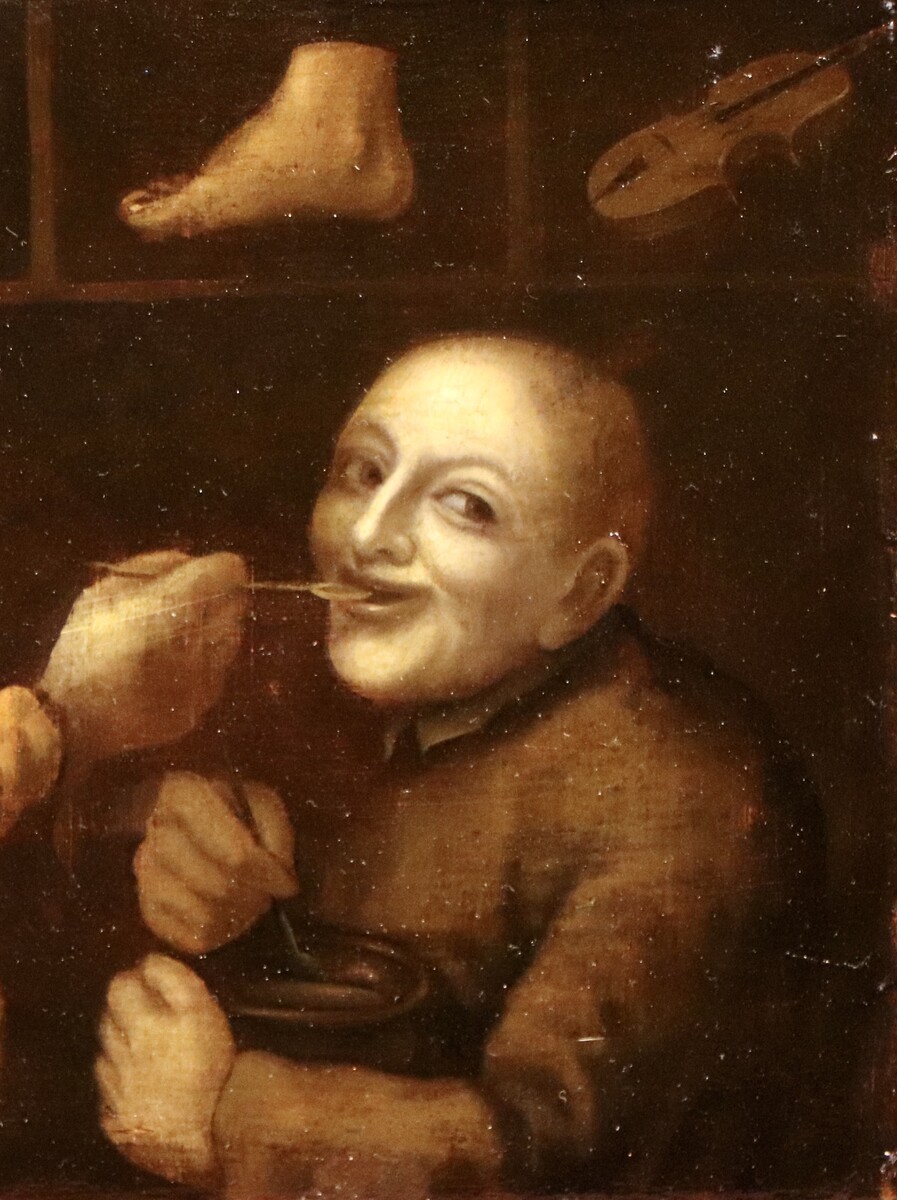
Flemish, Humanist, Renaissance culture knew many layers. In Antwerp around 1530, young Jan Massys painted a humorous rebus that clearly refers to the local Chambers of Rhetoricians, where amateur poets and theatre companies often competed with puns. This hilarious painting alluded to figures with primitive, ‘unchristian’ impulses in the underbelly of society: a ridiculous jester and an ill-mannered peasant. Figures that the city dwellers looked down on. The pictorial rebus at the top expresses a sixteenth-century Flemish proverb: ‘De wereld voedt vele zotten’ = ‘The world feeds many fools.’
There exist several copies of this composition.
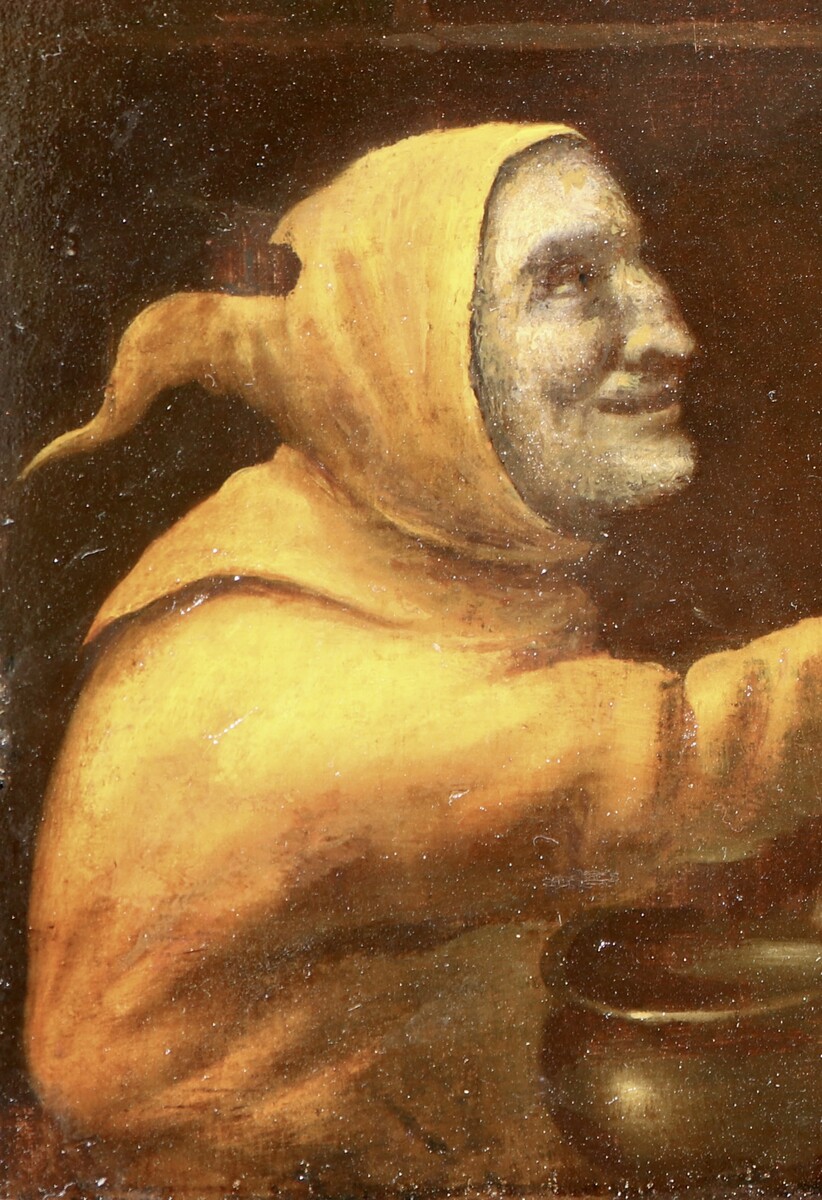
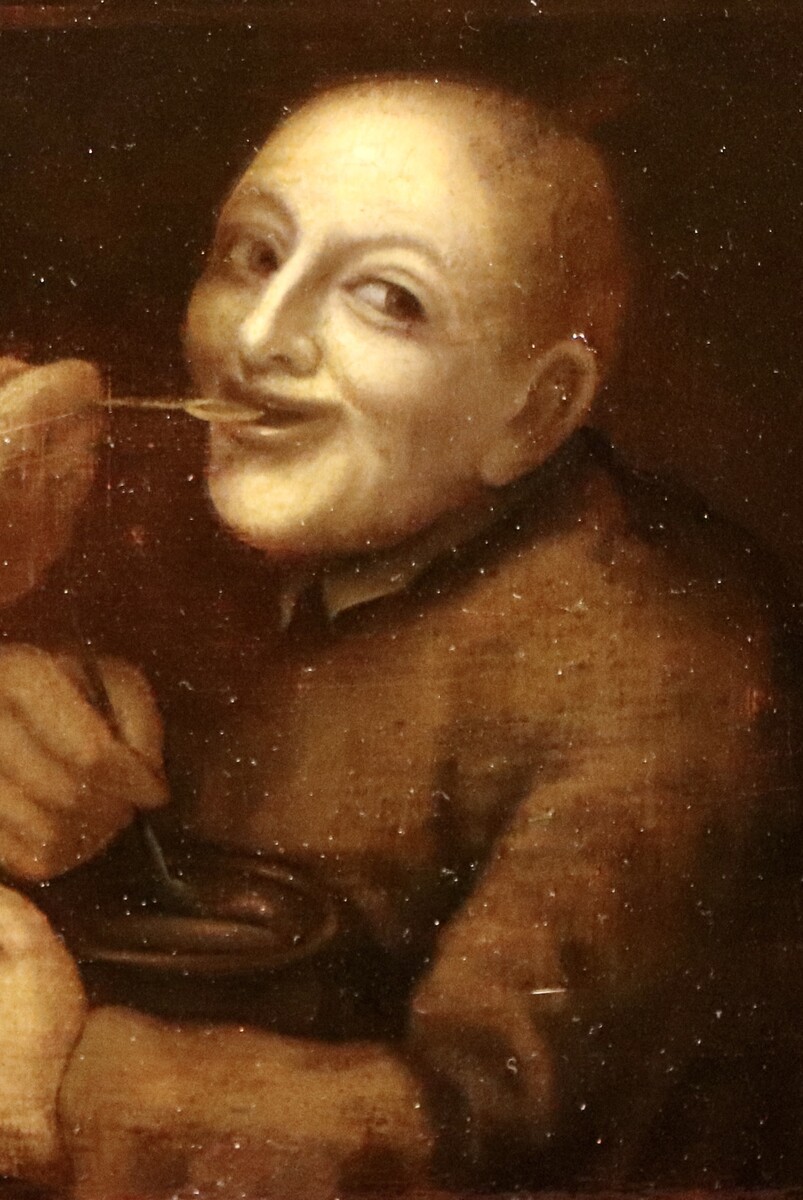
Our painter was clearly inspired by the original rebus, but his two figures do not resemble those of Jan Massys.
About the rebus in our painting
- The ‘D’ stand for ‘de’ = the article ‘the’
- The orb stands for ‘wereld’ = ‘world’
- The foot is a pun for ‘voedt’ = ‘feeds’
- The vielle refers to ‘vele’ = ‘many’.
Add to this the buffoon and the peasant and you get ‘the world feeds many fools’.
About Jan Massys
Flemish Renaissance painter
Antwerp 1509 – 1575 Antwerp
His last name is sometimes spelt Messys or Matsys.
Painter of genre scenes, history subjects (biblical and mythological), portraits and landscapes.
Pupil of his father, Quinten I Massys (Louvain 1465/66 – 1530 Antwerp), who was the first important Renaissance painter of Antwerp.
Brother of the landscape painter Cornelis Massys (circa 1510 – 1556/57 place unknown).
At his father’s death in 1530 Jan took over his father’s workshop.
He became a master in the Painter’s Guild in Antwerp in 1632, together with his brother Cornelis. During these years Jan was still strongly influenced by his father’s style.
Both brothers were banned from the Duchy of Brabant for heresy in 1544. It is assumed on stylistic grounds that Jan Massys travelled in 1544 to Fontainebleau: elongated Mannerist female figures became a key element in Jan’s art. During the period 1549-1555 he probably lived in Genoa.
December 1st 1555 he was again documented in Antwerp. Jan was rehabilitated and received several commissions from the city council. But he also produced a lot for the open market. The years after Jan’s return were very turbulent and uncertain in Flanders, resulting in an iconoclastic wave of destruction, the so-called Beeldenstorm in 1566. This lead to a strong Spanish military reaction under the Count of Alva: Antwerp was sacked in a horrible way (‘the Spanish Fury’) in 1576. Jan passed away one year earlier, so he did not have to live the destruction of many of his paintings.
Why should you buy this painting?
Because the humorous, burlesque message of this work never fades. Humour exposes the world.
Comparative paintings
Click photos for more details