4.700 €
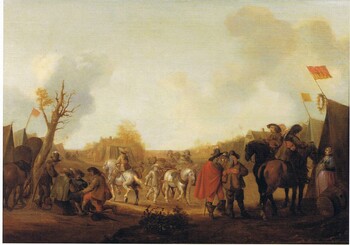
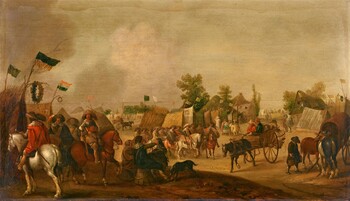
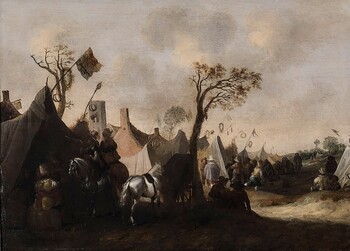
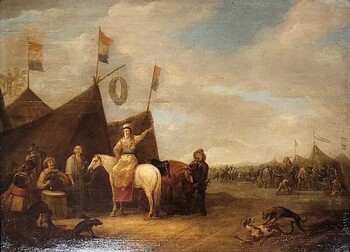
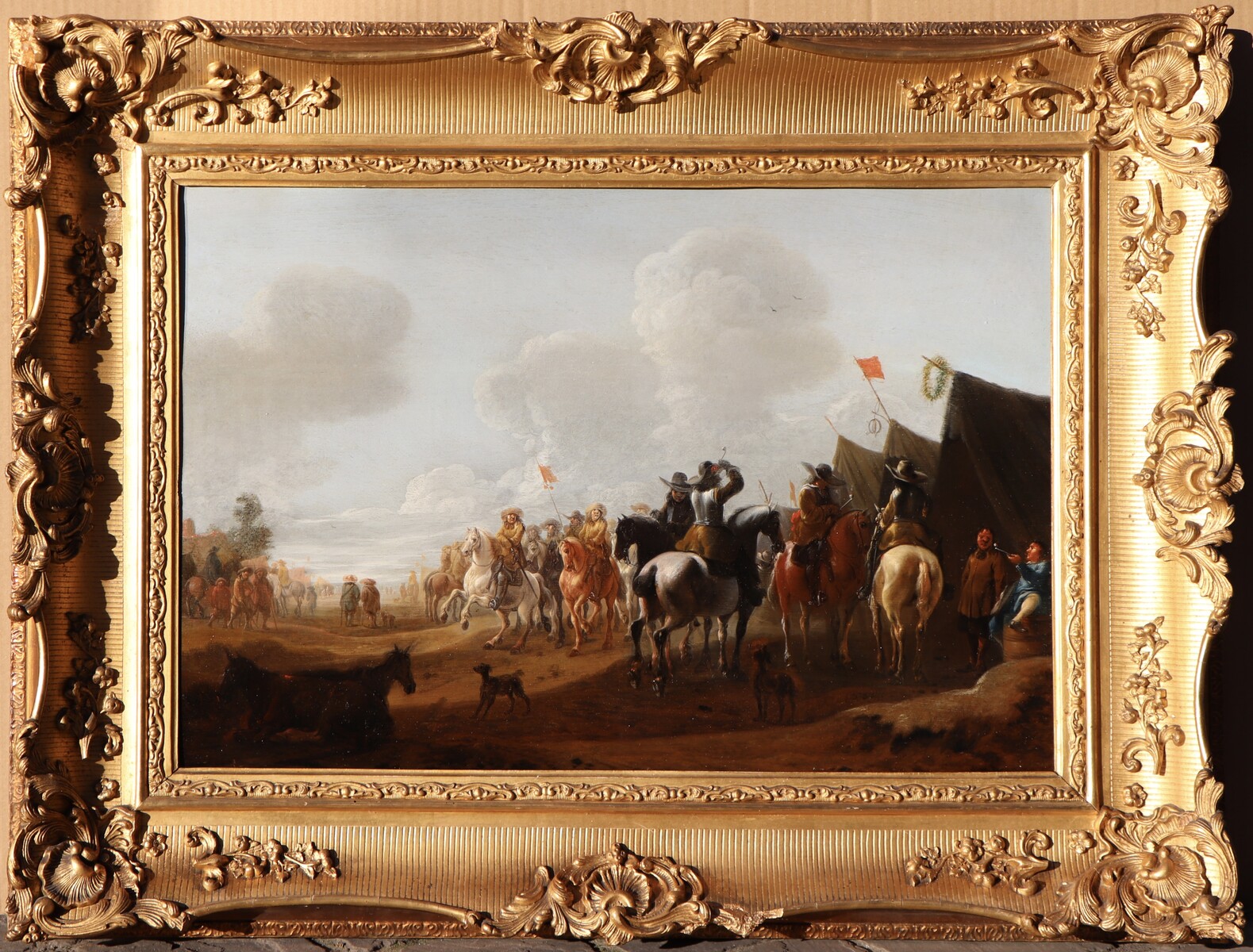
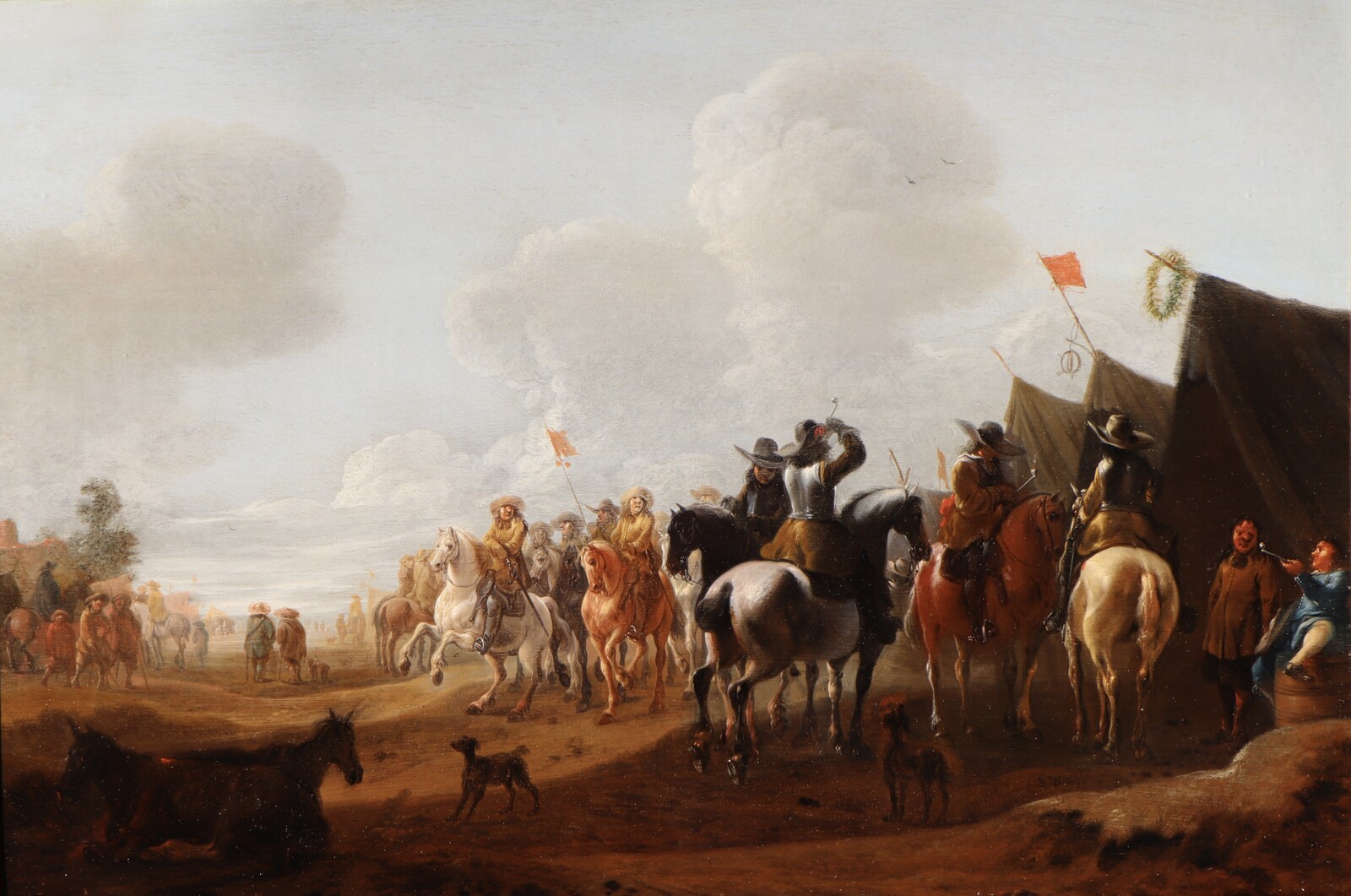
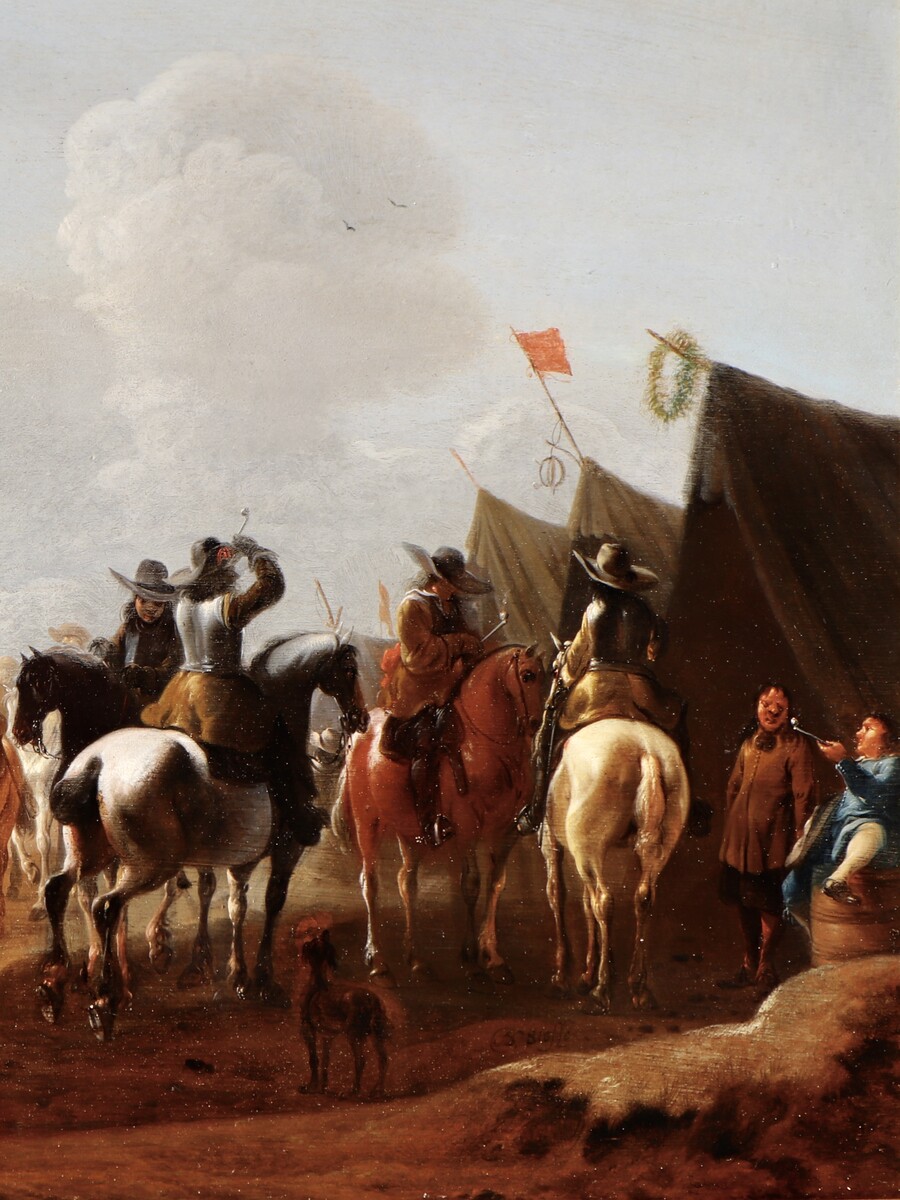
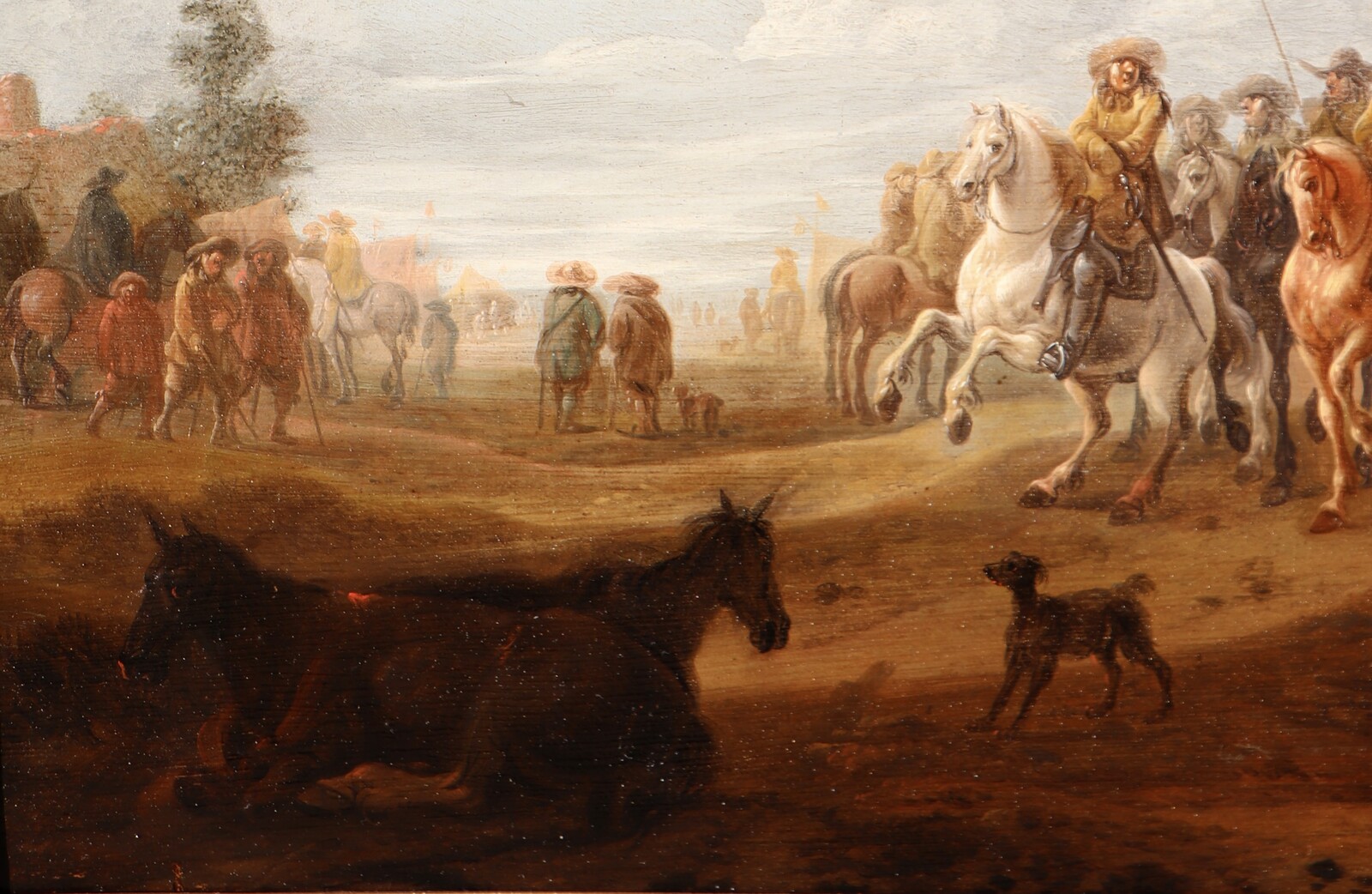
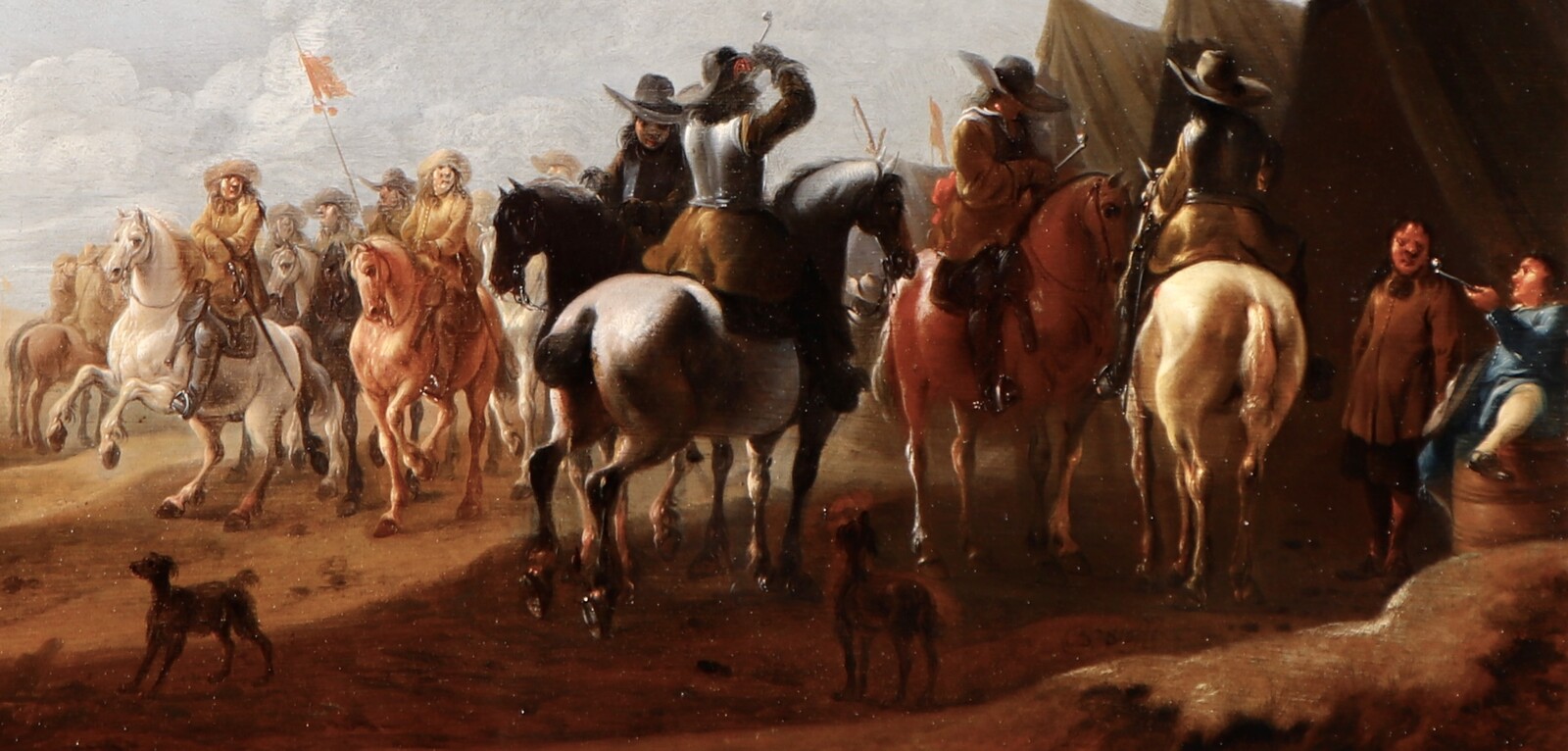
A military encampment
Oil panel : 43,2 X 64,3 cm
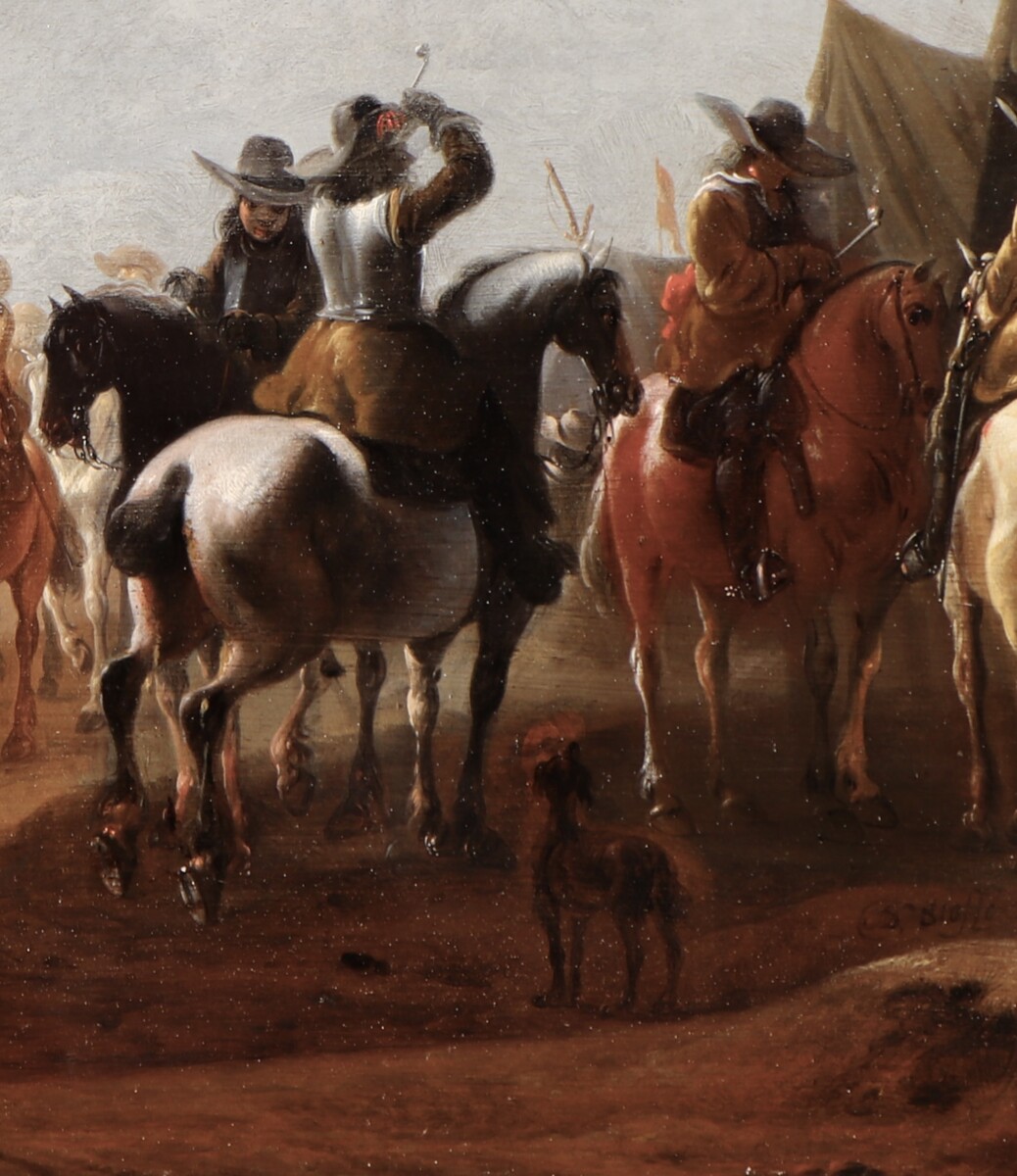
Signed lower right “JAD Stoffe”
(the “JAD” letters are intertwined)
Frame : 65,2 X 86,3 cm
About Jan Jacobsz. van der Stoffe
Dutch painter
Leiden circa 1610/11 – 1682 Leiden
Van der Stoffe is documented in Leiden between 1644, when he became member of the Painters’ Guild, and his death. In 1669 he was dean of that Guild.
His earliest painting dates from 1635.
Stylistically he stood very close to Abraham van der Hoef (Haarlem 1611/12 – 1666 Haarlem). Van der Stoffe and van der Hoef are considered as the most important Dutch battle scene painters of the last decade of the Eighty Years War, which ended in 1648, with the Peace of Westphalia. It sealed the recognition by Spain of an independent Dutch Republic. Both specialists depicted the intensity of battles with a lot of detailed precision.
About the representation of military encampments
The Eighty Years’ War was a war of sieges. Military engineers played an important role in the transport of troops, logistics, building fortifications, digging trenches and tunnels (so-called “sapps”) for undermining these fortifications. They were also responsible for the construction of military camps.
The best-known Dutch military engineer was Simon Stevin (Bruges 1548 – 1620 The Hague or Leiden). He was an advisor and tutor of Prince Maurice and became quartermaster-general of his troops in 1604. In his “Castrametatio” of 1617 he developed a sort of universal and flexible, linear system to build encampments in very diverse circumstances holding elements of Roman camps, but adapted to contemporary warfare. His extensive lists take into account where one has to stock even the smallest nail. He also made regulations to keep order in the camp: hygienic criteria, rules about selling beer, the place where could be cooked, where merchants would hold, etc.
The earliest Dutch paintings representing military encampments date from after the truce that ended in 1621. They were painted by Esaias van de Velde (the earliest one in 1622) and by Palamedes Palamedesz.. Until well after the Peace of Westphalia in 1648 these camps remained a popular subject. The realistic looking approach of the earliest representations shifted rapidly towards a sort of colourful, military genre scenes with many picturesque elements, placed against a landscape setting. As Erik Spaans (1998, P. 178) put it: “order and uniformity are vital to an army, but deadly for a painter”.
As so often in 17th century painting these representations look like realistic snap shots, but one has to see them as carefully build up compositions, in which the painter omitted all disturbing elements.
- Although these encampments used to be huge, sometimes as large as the besieged town, we only see a small fragment of them in paintings.
- Officers would sleep in tents, soldiers in huts: strangely enough one finds these huts back in engravings, but never on paintings.
- In almost all these painting one sees a tree. Knowing how much wood was needed for building the huts, parapets and fortifications, for keeping up the tents, cooking, etc., all trees would have disappeared very rapidly.
- Camps would hold a very diverse population, not only of soldiers and officers, but of specialised workmen: coach builders, drivers, carpenters, smiths, surgeons. There were taverns, bakeries, butcheries and other merchants grouped in a market.
- In a 17th century field army the officers and soldiers were by far outnumber by the civilians travelling with them.
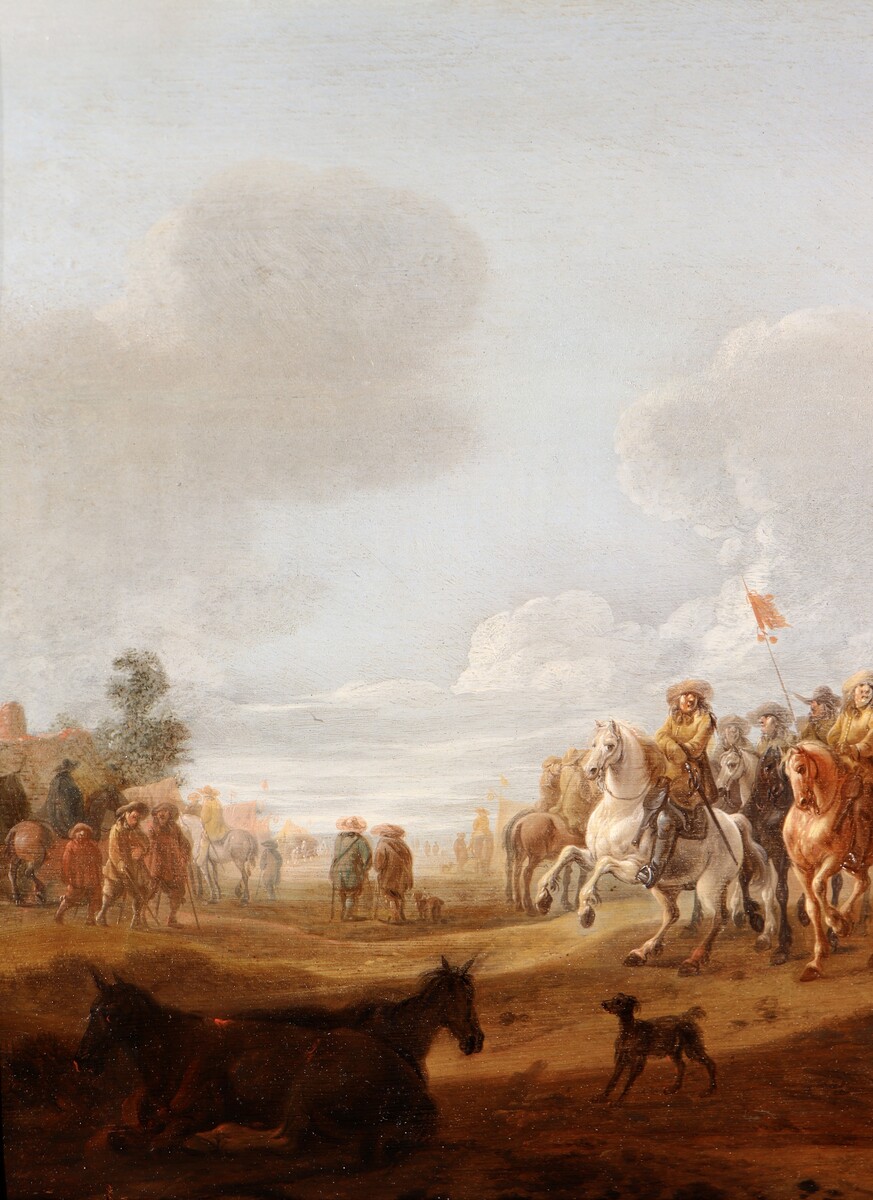
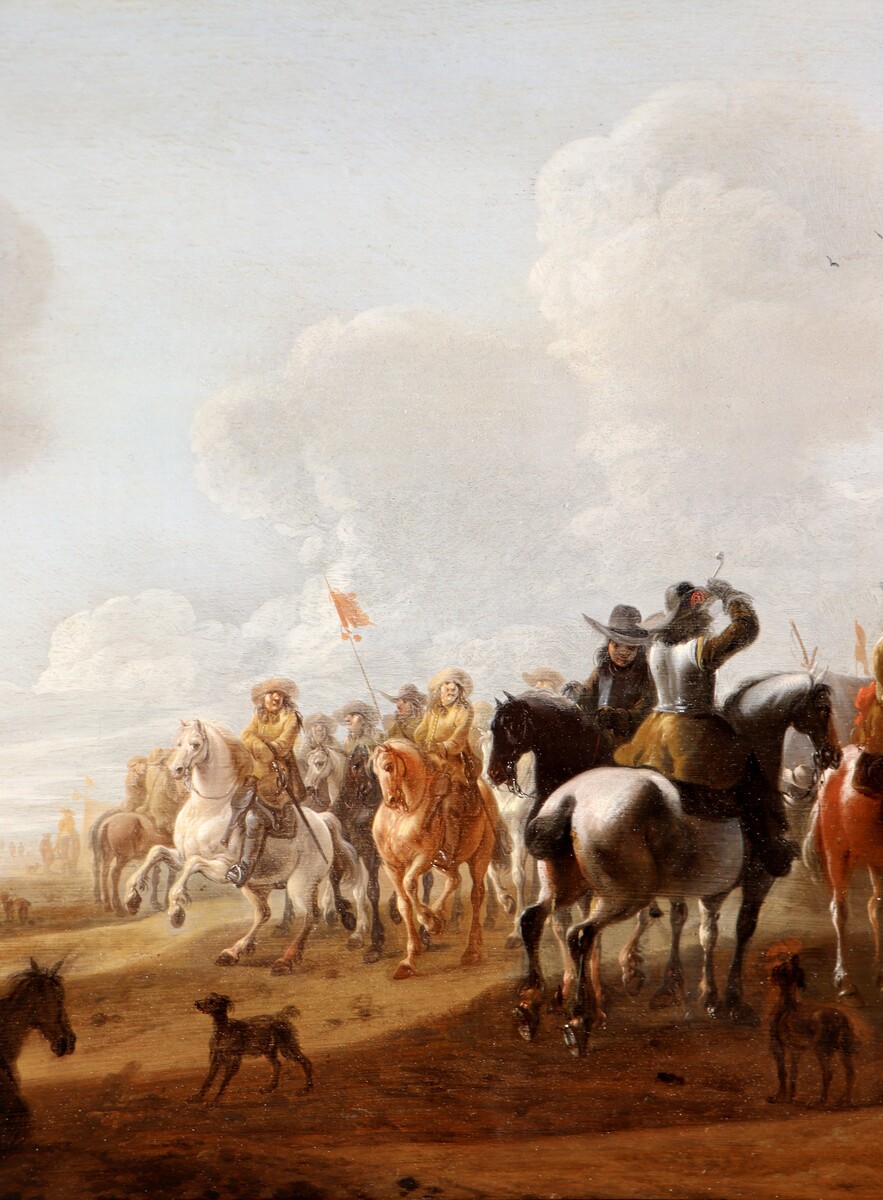
As can be seen in our painting wifes would accompany their husbands with their small children.
A separate category formed of course the prostitutes. While the Catholic Church had regarded prostitution as a necessary evil, made sadly unavoidable by the sinful state of humanity, in the new Protestant societies it was prohibited. Whenever a city was taken over by the Calvinists during the course of the Dutch Revolt in the late 16th and first half of the 17th century, one of the first acts of the new city government was to close down the municipal brothels and to suppress prostitution.
But this prohibition was impossible to maintain in a military society.
Prostitution was condemned from the pulpit but regulated by the military engineers, as for example by Simon Stevin.
Female sutlers would also make some money as prostitutes.
About our painting
This must be an early painting by van der Stoffe. He did not often paint military encampments, as he specialised in cavalry battle scenes. These camp representations must date from before the Peace of Westphalia, which ended the Dutch war of independence (The Eighty Years’ War) in 1648. The low horizon line is also typical of the late 1630s and 1640s.
Comparative paintings
Click photos for more details