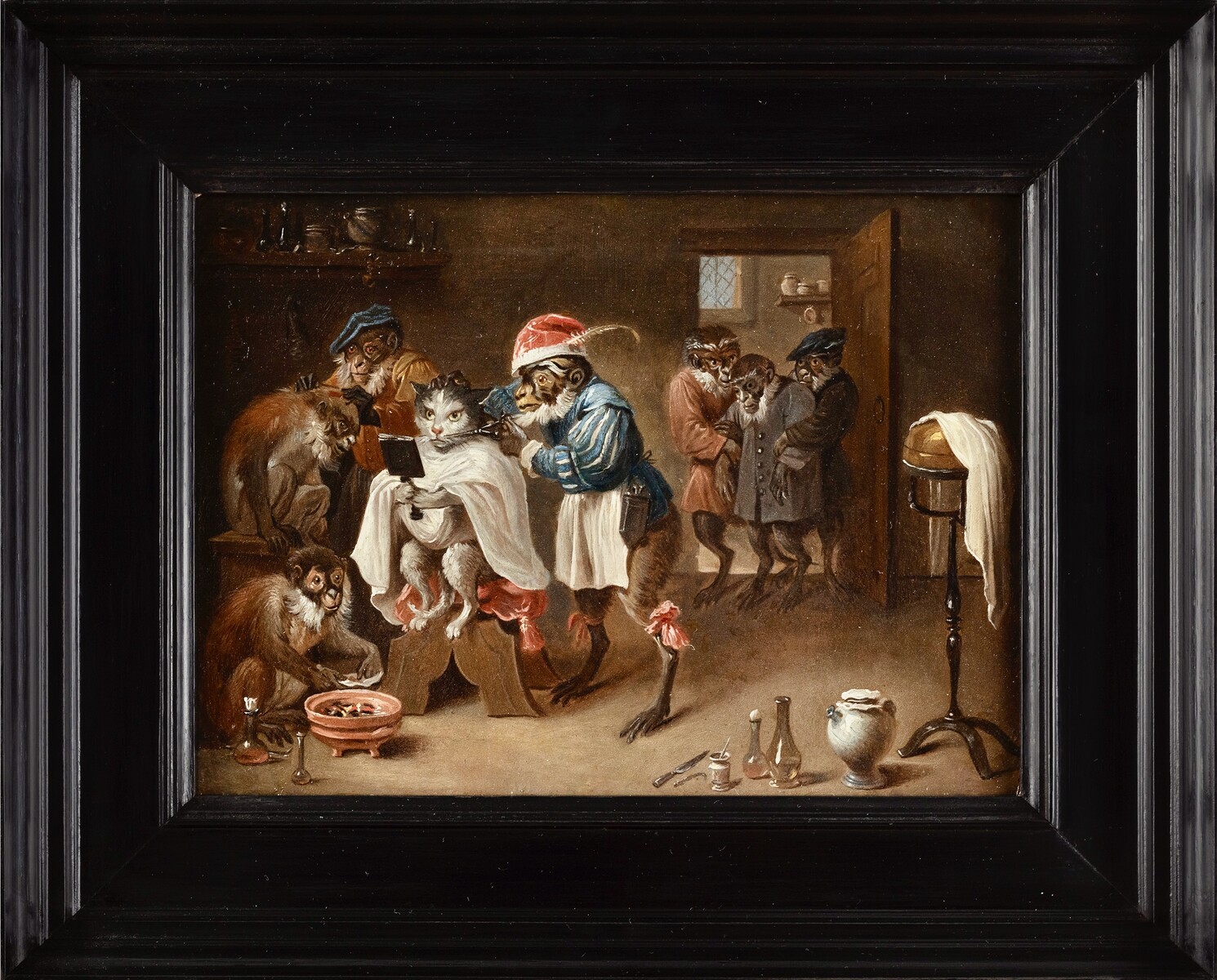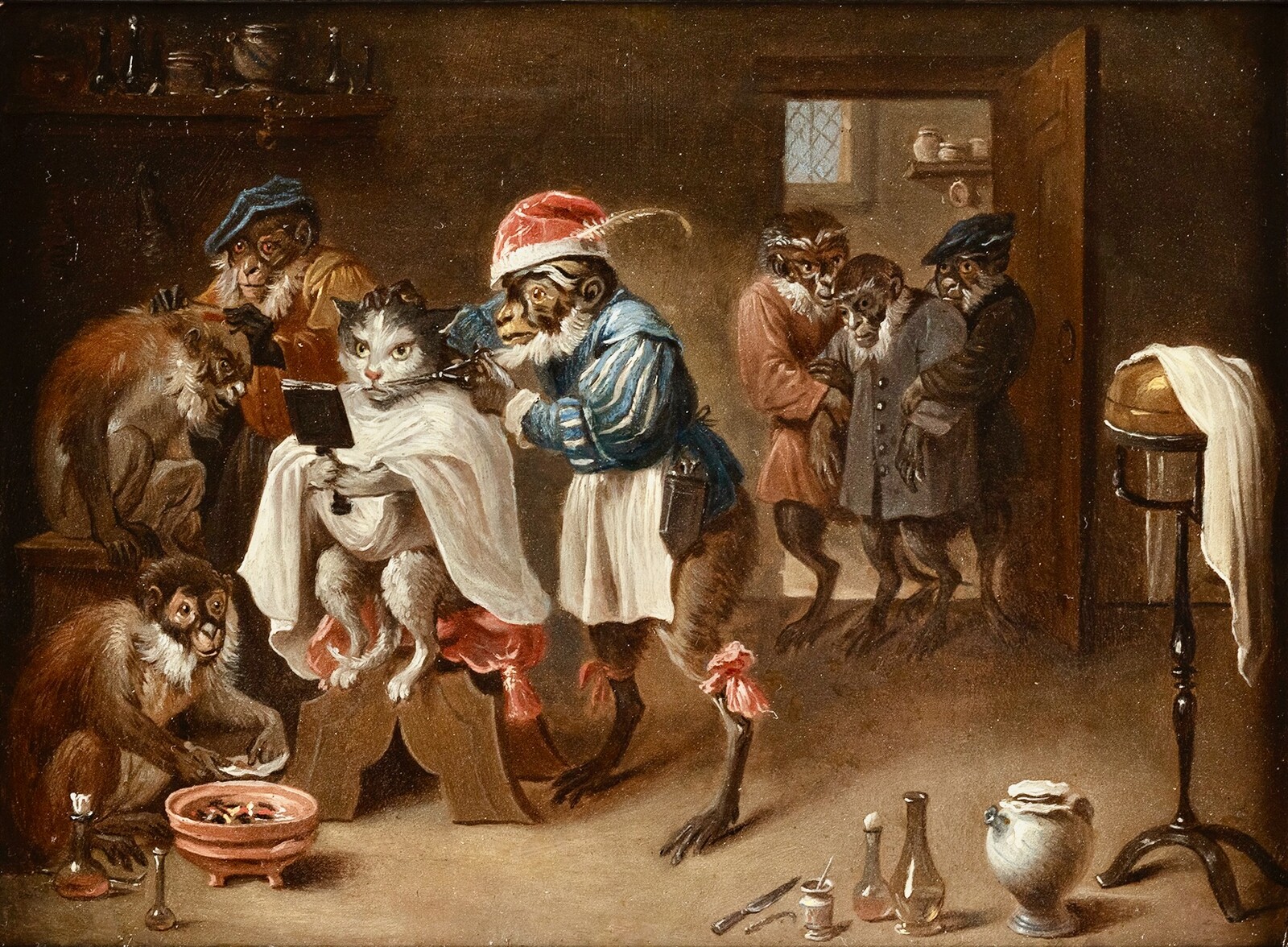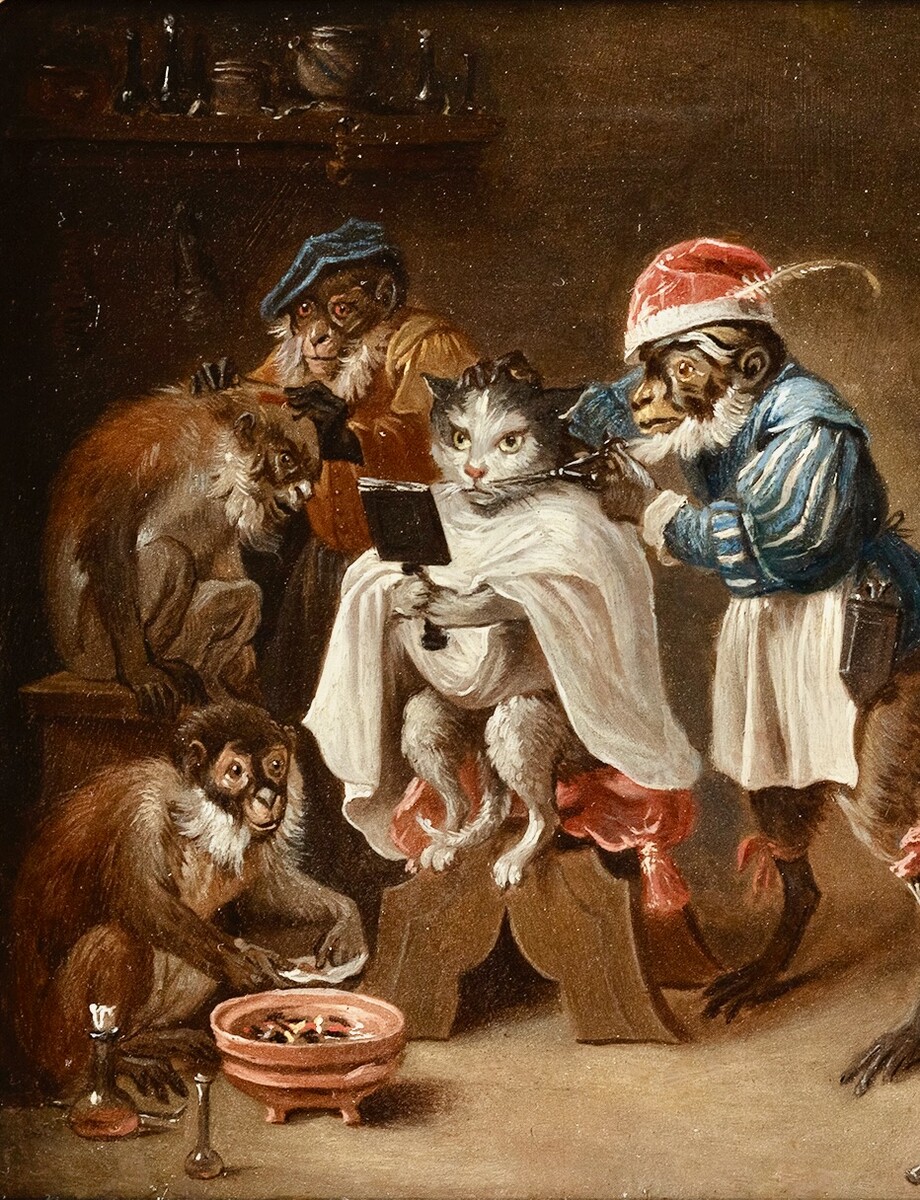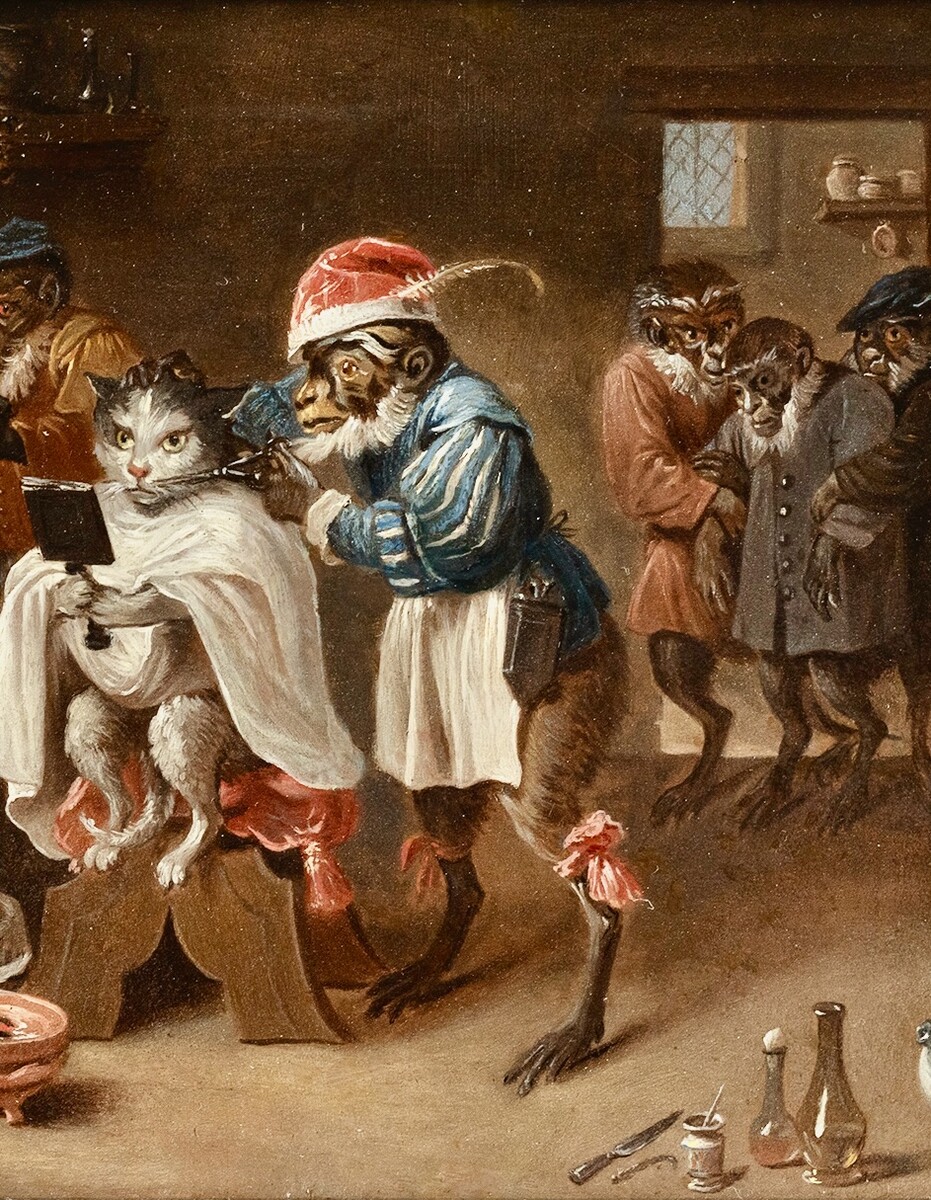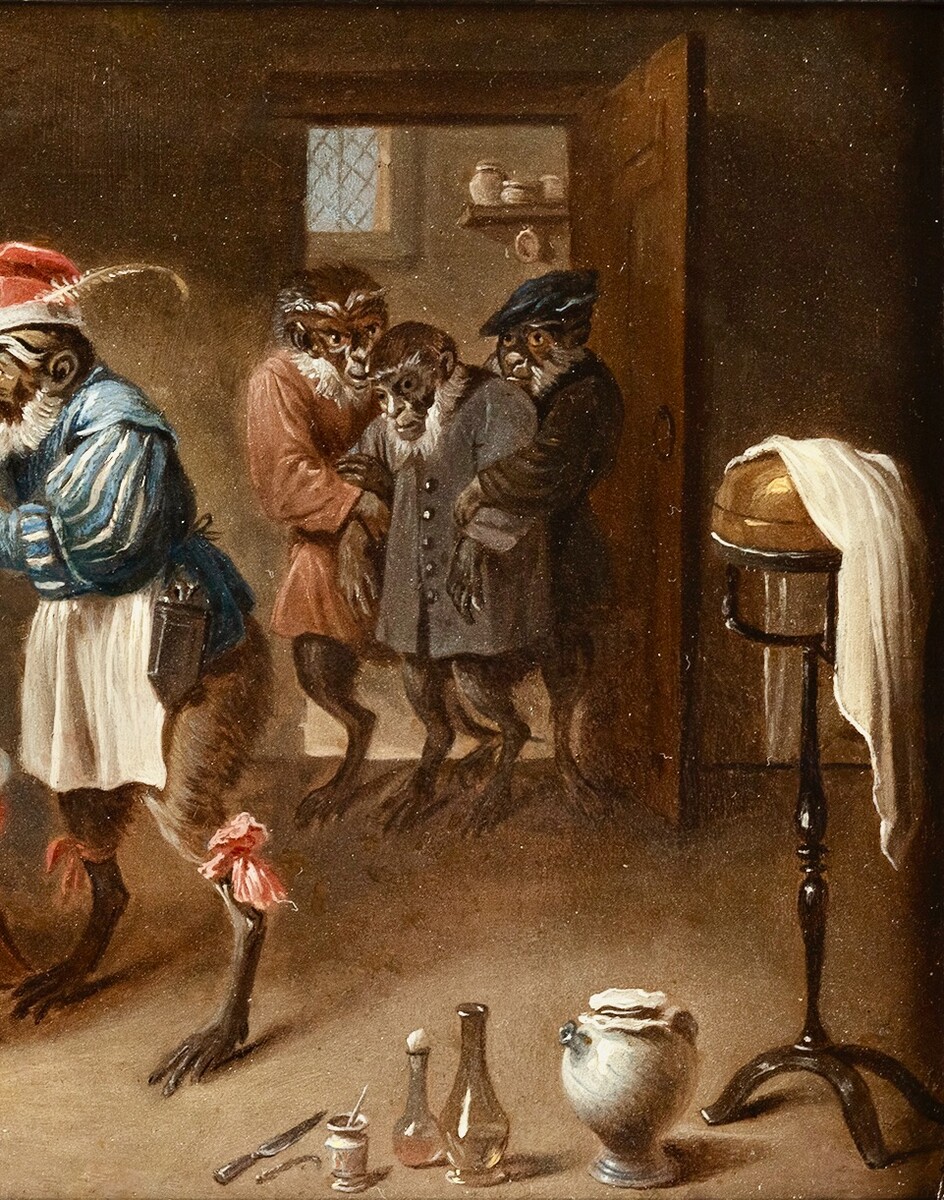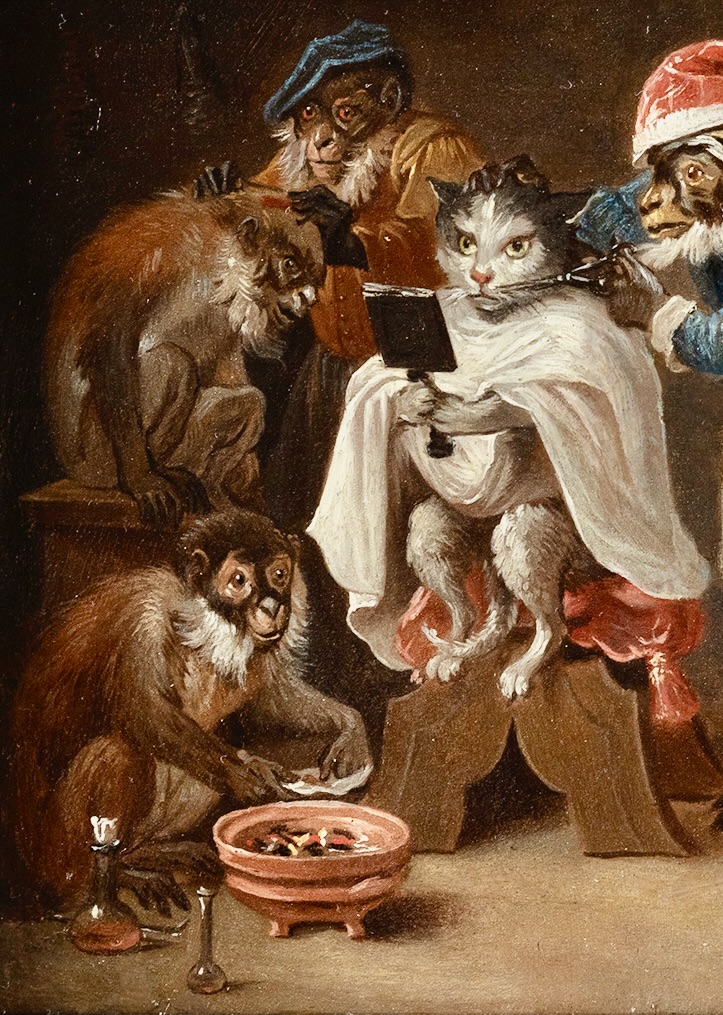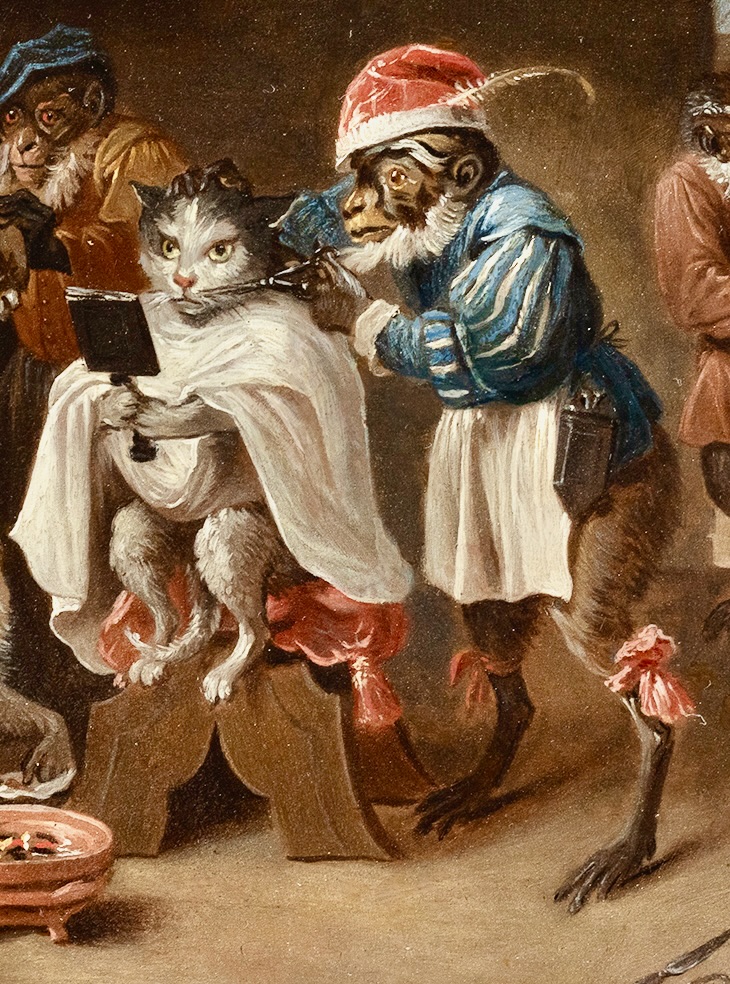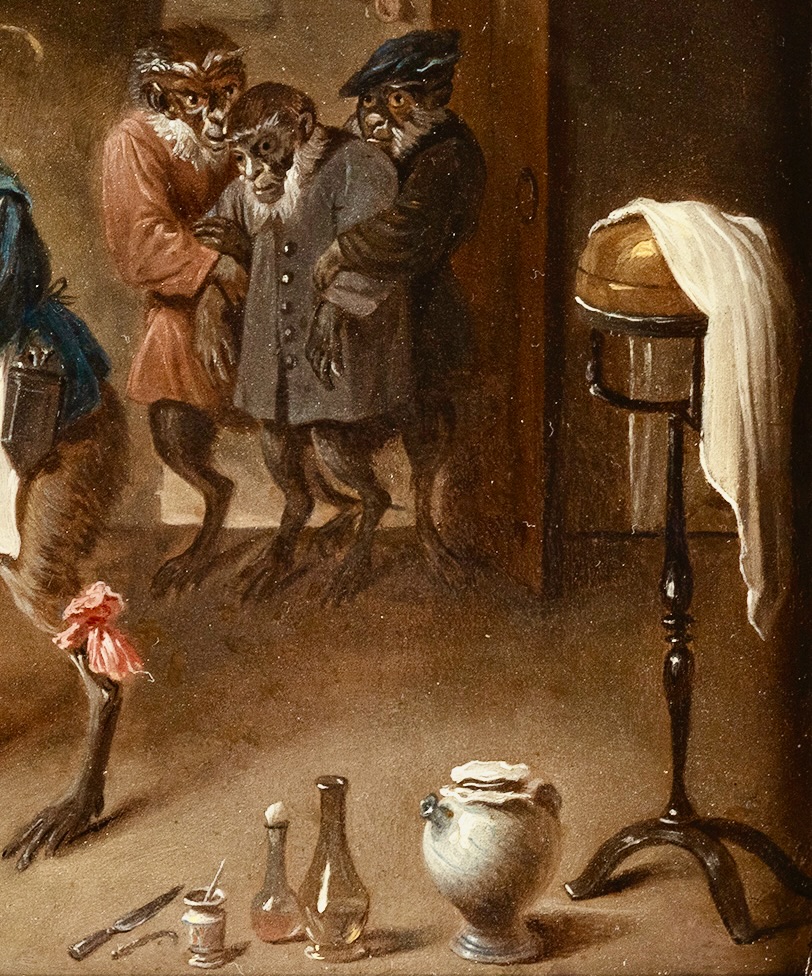
Singerie with a cat at the monkey-barber
Oil on copper : 16,7 X 22,6 cm
Unsigned
Frame : 25,7 X 31,7 cm
Provenance : sold at Tajan Paris, 27/03/95 as by Ferdinand van Kessel I
for 170.000 FF (+ buyer’s premium) = 25.916 € (+ BP)
In short
Satirical paintings with monkeys, so-called monkey-tricks or singeries, were popular during the 17th century in Flanders. This popularity should be seen against the contemporary political, social and even military context. Thru absurd mockery criticism could safely be revealed.
Ferdinand van Kessel the Elder is known to have painted regularly monkey scenes.
About Ferdinand I van Kessel
Flemish painter
Antwerp 1648 – 1702 Breda
Painter of singeries with monkeys and cats, of genre scenes, allegories and still lifes.
Ferdinand I was a son and pupil of Jan I van Kessel (1626 – 1679), who had 13 children, grandson of Jan Brueghel I, who was a son of Pieter Brueghel the Elder.
Some sources mention erroneously that in 1680 and in 1688 Ferdinand I is documented in Amsterdam.
In fact he had moved from Antwerp to Breda. Here he made ceiling paintings for the large palace (Kasteel Prinsenhof) of the Dutch Stadtholder and later English King, William III.
In Breda van Kessel was contacted by the Polish ambassador to The Hague, Antoine Moreau some spell his last name Molo), to paint a series of cabinet paintings for the Polish King Jean Sobieski III, for the palace of Wilanow. In 1694 the King appointed van Kessel as his court painter. Several orders for more series for the palace followed.
Ferdinand the Elder had two well-known pupils in Breda: Jacob Campo Weyerman and Louis de Moni.
Attributions of unsigned monkey scenes are extremely difficult.
A lot of 17th century Flemish monkey trick paintings are attributed in full to Ferdinand van Kessel who is known indeed to have painted regularly apes. But not a single fully signed singerie is known by him. Still, based on stylistic comparison with other subjects some of them may indeed be given to van Kessel.
Other contemporary Flemish painters of singeries are David II Teniers and his younger brother Abraham, Sebastiaen Vrancx, Frans Francken II and Nicolaes van Verendael.
About monkey tricks
“Singeries” or monkey tricks were a popular subject in Flemish painting during the 17th century and later in French Rococo painting during the 18th century.
Comical scenes with monkeys behaving like humans had been introduced in Flemish art by the Renaissance engraver Pieter van der Borcht the Elder (circa 1530 – 1608) around 1575 in a series of prints.
Typical of the Flemish monkey scenes is their sense for satirical humour, often with a moralizing tendency, criticizing the monkeys’ and therefore man’s (stupid) behaviour and his sense for social hierarchy.
Later in French painting these subjects received, typical of the Rococo period of course, a more decorative and less sharp meaning, often in combination with Chinese decors.
I should also mention in applied arts the famous porcelain monkey orchestras produced in Saxony, Germany, at the Meissen factory from around the middle of the 18th century onwards.
The popularity of these singeries in Flanders should be seen against its historical context: Flanders was since the Middle Ages one of the richest regions of Europe, but it had always been in the hands of foreign powers. Mild forms of satire and a sense for “surrealism” were a second nature for our writers and artists.
It might seem rather surprising to us that, long before Darwin’s ‘On the Origin of Species’ (1859), painters turned to monkeys imitating man’s basic behaviour. Since Antiquity monkeys were considered stupid animals who, with their eyes wide open, are merely copying human foolish behaviour, without fully understanding it: monkeys and cats were vain animals driven by their instincts.
Why should you buy this painting?
Because it is a nice, detailed example of a 17th century Flemish singerie.
Comparative paintings
Click photos for more details