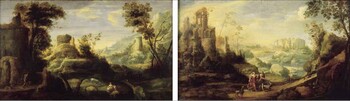
4.300 €
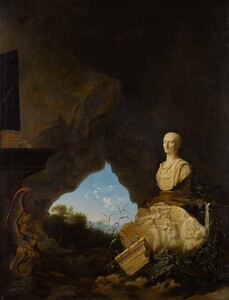
Ottoman hunters admiring Roman artwork in a cavern
Oil on panel : 35,0 X 31,3 cm
Faintly signed bottom left “Hatic.. F”
Frame : 46,2 X 42,8 cm


About Petrus van Hattich
Dutch painter
The Hague before 1620 – after 1665
Painter of Italianate cavern interiors and landscapes.
There is very little information about our painter.
We do not know whom he studied with.
He married in 1638 in Overschie, near Rotterdam.
He is documented in Utrecht between 1647 and 1665. Grotto interiors were indeed popular in Utrecht, where two other specialists also lived here:
- Charles de Hooch (1577 – 1638) was born in The Hague, but he was active in Utrecht from 1628 until his death.
- Abraham van Cuylenborch (1620 – 1658) remained all his life in Utrecht.
About grotto scenes
During the 17th century Italy's landscapes, antique culture and monuments, warm Southern light and lively population formed a source of inspiration for numerous Northern artists, especially for Dutch and Flemish painters.
Several Dutch painters, such as Charles and David de Hooch, Abraham van Cuylenborch, Rombout van Troyen or Petrus van Hattich specialised in so-called grotto interiors with antique monuments.
Others like Cornelis van Poelenburch, Dirck Stoop, Jacob Muller and Willem van Bemmel regularly chose these mysterious, somewhat melodramatic surroundings for their paintings.
Of other painters, for example Jan Asselijn, Jan Griffier I and II, or Alexander Havelaar just one or two cavern interiors are known.
The figures within the cavern scenes were either mythological (Diana and her nymphs) or contemporary figures (visitors, shepherds).
The inventor of this new subject must have been Cornelis van Poelenburch, who had returned from a stay in Italy (Rome: 1617 – 1625 and Florence: circa 1625 – 1626) to his native Utrecht in 1627.
Why did Dutch painters choose, from all possible Italian places and subjects, caves as a subject? Italy is not particularly known for its caves filled with Roman ruins and tombs.
But then one must think of ancient ruins discovered between the late 15th century and the start 17th century during “archaeological” excavations, such as:
- the remains of the Domus Aurea of Nero on the Palatine Hill in Rome,
- the huge temple of Fortuna Primigenia under the town centre of Palestrina,
- the Nymphaeum at Hadrian’s Villa in Tivoli,
- the catacombs in and just outside Rome.
Another reason explaining the popularity of paintings representing grotto interiors could be that in 16th and 17th century Italian shepherd plays set in Arcadia, nymphs, satyrs and even shepherds lived in them. The final of the in 1589 published and all over Europe immensely popular “Il pastor fido” from Giovanni Battista Guarini (1538 – 1612) is also set in a cavity.
These cavern interiors are all about vanity and decay. The scenery is not just decorative and beautiful, it is meant to inspire its viewers to wonder about deeper religious and philosophical ideas, to meditate about death and resurrection, about the ephemeral character of life.
Typical is the ruined state of the monuments. Columns, sarcophagi, sculptures stand under poetic, almost magic grotto vaults, strangely lit by light reflecting on water of a spring, an underground lake or river bed.
About Arcadia
Arcadia refers to a vision of pastoralism and harmony with nature. It is derived from the Greek province of the same name, dating from antiquity. The province's mountainous topography and sparse population of shepherds later caused the word ‘Arcadia’ to develop into a poetic byword for an idyllic vision of an unspoiled, Mediterranean wilderness, uncorrupted by civilization. It was regarded as unattainable or as a lost.
Arcadia became an idealised phantasy dreamland in poetry. Best known are:
- the popular pastoral tragicomedy “il pastor fido” by Battista Guarini (1590);
- the translation in Dutch by Karel van Mander of the “Bucolics” of the Roman poet Virgil (1597);
- the famous play “Granida” by Pieter Cornelisz. Hooft (1605).
In painting Arcadian scenes are characterised by an Italianate landscape (hills bathing in a warm sunlight) populated with nude or scarcely dressed figures.
Why should you buy this painting?
Because of its exotic poetry.
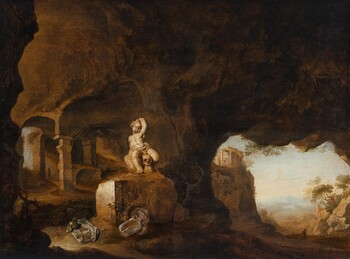
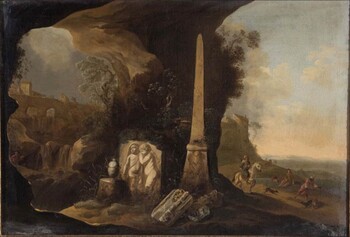
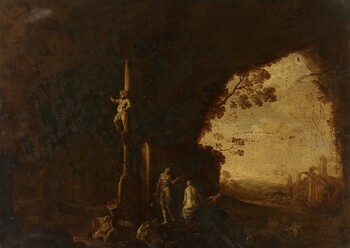
Comparative paintings
Click photos for more details